
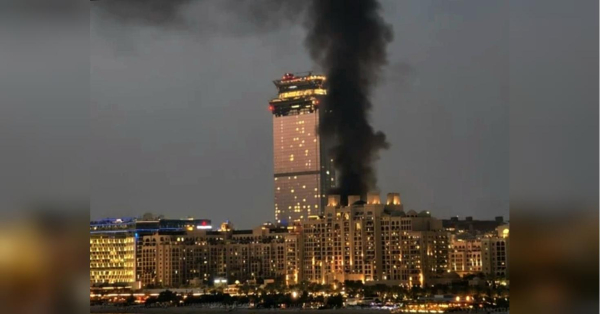
On February 28, the US Army and the IDF launched a military operation against Iran with the aim of destroying the country's military-political leadership and nuclear program. In response, Tehran launched ballistic missiles at Qatar, the UAE, Bahrain and several other countries in the Middle East.
VIDEO OF THE DAY
Escalation is gaining momentum
Also, amid the military action, Iran has blocked the Strait of Hormuz. About 30% of the world's oil trade passes through it, the Iranian Fars news agency reports. Oil tankers are already standing near it and will not go any further. If the blockade continues, world oil prices will jump sharply, which will play into Russia's hands.
An official from the European Union Naval Mission, Aspides, said that the ships received radio transmissions from Iran's Islamic Revolutionary Guard Corps, which stated that “no ship has the right to pass through the Strait of Hormuz,” the Times of Israel reported.
The closure of the Strait of Hormuz would hit oil imports to India, South Korea, China and Japan. India has already announced that it has sufficiently diversified its oil imports, while Japan, which imports 90% of its oil from the Persian Gulf, is introducing subsidies for its gas stations, just in case, to avoid a price collapse. China has so far evaded answering questions.
ADVERTISING
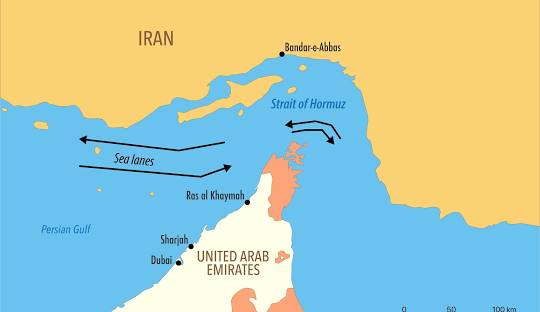
IRGC announces ban on ships from passing through the Strait of Hormuz
OPEC members Saudi Arabia, Iran, the UAE, Kuwait and Iraq export most of their crude oil through the strait, mainly to Asia. Qatar, one of the world's largest exporters of liquefied natural gas, ships almost all of its liquefied gas through the strait.
Dubai and Abu Dhabi are attacked with missiles and suicide bombers
The UAE reports several waves of Iranian drone and missile attacks, with one person killed by falling debris. Dubai airports have suspended operations, with eyewitnesses posting footage of falling debris and fires.
ADVERTISING
The UAE Ministry of Defense condemned the attack and considered it a gross violation of national sovereignty and international law.
“The UAE reserves the full right to respond to this escalation and take all necessary measures to protect its territory, citizens and residents, and to preserve its sovereignty, security and stability,” the statement said.

UAE attacked by missiles and drones
In addition, two airports in Dubai have also been closed indefinitely. In particular, Dubai International Airport, which is considered the busiest airport in the world by international passenger traffic. Thousands of passengers were left stranded, while local police and airlines are trying to organize evacuations.
ADVERTISING
“Flight operations at DXB and Dubai World Central – Al Maktoum International (DWC) are suspended until further notice. Guests are advised not to travel to the airport and to check flight information with their airlines,” Dubai Airports said in a statement .
Eyewitnesses write that the Shaheeds are flying near the Burj Khalifa. There are arrivals. People are being evacuated from hotels and the skyscraper. There are a lot of cars leaving the city.
Kuwait International Airport was also hit.
Several airport workers suffered “minor injuries,” Kuwait's General Directorate of Civil Aviation said.
“A drone attacked Kuwait International Airport, causing minor injuries to several employees, as well as minor material damage to the passenger terminal (T1),” the report said.
Work is currently underway to assess, eliminate the consequences, and restore operational processes.
In Bahrain, Iranian drones attacked residential buildings.
“The Ministry of Interior, through Civil Defense, is dealing with the damage to three buildings in Manama and Muharraq caused by drone attacks and the fall of fragments from an intercepted missile. The first building has been evacuated and the fire has been brought under control,” the report said.
Khamenei, Nasirzadeh and Pakpour could have died in a strike on Iran
Israeli officials estimate that Pakpour was likely killed in the early morning strikes on Iran. He led the Islamic Revolutionary Guard Corps after Israel killed his predecessor, Hossein Salami, at the start of the war in June 2025.
Iran's Supreme Leader Ayatollah Ali Khamenei
In addition, Israeli officials told reporters that Nasirzadeh and the head of Iran's intelligence service were also likely killed in the morning strike. The Israeli Channel12 television channel also reported the death of Iran's supreme leader, Ayatollah Ali Khamenei. It is noted that the strikes caused “very significant damage” to the leadership of the Iranian regime and its military commanders. The Hamshahri Institute, affiliated with the Tehran municipality, reported the death of Khamenei's son-in-law and daughter-in-law.
Later, Israeli Prime Minister Benjamin Netanyahu said that there were many signs that Iran's Supreme Leader Khamenei was no longer alive.
Netanyahu called on Iranians to “take to the streets en masse” to overthrow the regime. He said the strikes would help them “liberate themselves from tyranny.” He also announced strikes on thousands of targets in the coming days. He said they had a “unique chance” to overthrow the Iranian regime: “Take to the streets en masse” and “do your job.”
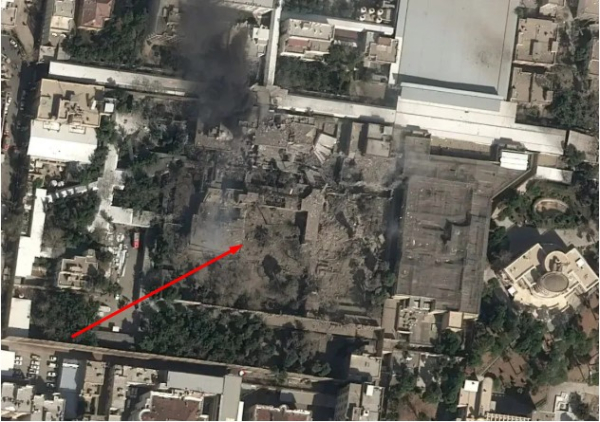
Khamenei's palace in Tehran after the attack
There is no exact evidence and confirmation of Khamenei's death yet. The Iranian authorities do not answer such questions, or even deny the claims about the death of the leader and other high-ranking officials. At the same time, a number of media outlets are reporting the cancellation of the previously announced address by Ayatollah Ali Khamenei to the Iranian people.
IDF reports largest airstrike in history
The Israel Defense Forces said that about 200 fighter jets were involved in the military operation against Iran, dropping munitions on approximately 500 targets. The IDF calls this operation the largest in the history of the Israeli Air Force. The missile complexes and defense systems of the Iranian terrorist regime in western and central Iran were attacked.
It is reported to be the largest “military flight” in the history of the Israeli Air Force (IAF), “carried out after careful planning and based on high-quality intelligence, with the simultaneous synchronization of hundreds of fighter jets.”
Previously, FAKTY wrote about what the war in the Persian Gulf means for Ukraine.