

Iran has threatened to close the Strait of Hormuz after US strikes on its nuclear facilities. This threatens global energy security, as 20% of the world’s seaborne oil supplies pass through the strait. Oil prices have already jumped to a five-month high, and markets are reacting with panic. How will this affect the economic and geopolitical situation in the world? The main points from the analysis of the WSJ, FT and Reuters
Buy an annual subscription to 6 Forbes Ukraine magazines with informative materials, ratings and analytics from UAH 1,350 .
Iran’s parliament has voted to close the Strait of Hormuz after the United States joined Israeli strikes on Tehran’s nuclear facilities, the WSJ reported. Iran’s Supreme National Security Council must now make a final decision on whether to close the strait after the US bombing on Sunday, June 22, Reuters added, citing Iran’s Press TV. This caused panic in oil markets and a decline in US stock futures on Sunday, June 22.
Two supertankers, the Coswisdom Lake and the South Loyalty, each capable of carrying up to 2 million barrels of oil, have already chosen a route that bypasses the Strait of Hormuz. The escalation in the Middle East is increasing the risks for commercial shipping in the region.

Popular Category Money Date Yesterday Quiet renewal, new mega-ministries and old staff. The President’s Office dared to change the Prime Minister for the first time during the war. How the government renewal was prepared and who will become ministers
Meanwhile, the US military is already developing a contingency plan in case Iran follows through on this threat. Iran’s missile and drone strikes pose a serious threat to US bases and facilities in the region. Some experts also fear that the Al-Quds unit, which acts as a proxy force for Iran, could attack US forces.
The cost of the Strait of Hormuz to the world
The Strait of Hormuz, a narrow 20-mile- wide strip of water that carries about 20 percent of the world’s seaborne oil shipments and a significant portion of liquefied natural gas, is a critical route for China’s energy supplies, the U.S. auto industry, and the U.S. aviation industry.
Oil shipments through the strait are also important for the automotive, chemical and power industries around the world, and fuel China’s oil-hungry economy, the WSJ said. The shipments also affect the prices paid by U.S. drivers and airline passengers. Iran has repeatedly pressured foreign-flagged tankers in the region and has occasionally threatened a broader trade blockade in times of tension, a move that could roil financial markets and send global energy prices soaring.
Closing the strait would be “suicide” for Iran, US Vice President J.D. Vance said on NBC. “Their entire economy runs through the Strait of Hormuz,” he added. Hamidreza Azizi, a research fellow at the German Institute for International and Security Affairs, says the decision will depend on the level of threat to the regime: “Strategically, Iran could view short-term economic sacrifice as leverage. But at the same time, it would mean giving up its only source of global energy revenue and risking a long-term blow to its reputation.”
Former tanker company executive and U.S. Navy military intelligence analyst Anthony Gurney stresses, “Once [the Iranians] use the strait as a bargaining chip, it’s lost.” He warns that a complete closure would trigger a swift U.S. military response and turn it into a protracted operation.
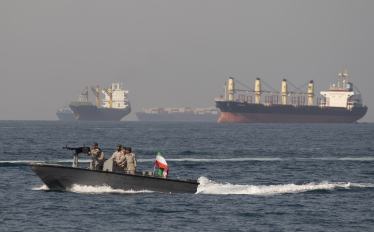
About 20% of the world’s seaborne oil supplies pass through the Strait of Hormuz every day . Photo Getty Images
Five-month record
Oil prices hit a five-month high after US strikes on Iran’s nuclear facilities, raising the possibility of Tehran attacking the region’s energy infrastructure or shipping in the Strait of Hormuz.
Brent crude jumped to $81.4 a barrel at the opening of trading on Monday, June 23, in Asia, before falling to $78.8, up 2.3% on the day. The US benchmark West Texas Intermediate also rose to $75.5. Prices have already risen by about 14-15% since Israel launched its first surprise attack on Iran 10 days ago. Higher oil prices are likely to affect other energy markets, including gasoline, which could trigger a new surge in global inflation.
Iran exports about 2 million barrels of oil a day, while about 21 million barrels of oil from Iran, Iraq, Kuwait, Saudi Arabia, Qatar and the UAE pass through the Strait of Hormuz every day, the FT notes. About a third of the world’s seaborne oil supplies pass through this narrow waterway that separates Iran from the Gulf states. Any attacks on ships in the strait could lead to a surge in energy prices.
“A clear red line has been crossed,” said Jorge Leon, head of geopolitical analysis at energy consultancy Rystad. He noted that the weekend airstrikes were the first direct US attack on Iranian territory. “In an extreme scenario, if Iran retaliates with direct strikes or attacks regional oil infrastructure, oil prices will skyrocket,” he said. “Even in the absence of an immediate response, markets are likely to price in an increased geopolitical risk premium.”

On the night of Saturday, June 21, the US launched strikes on Iran’s nuclear facilities, including in Tehran. Photo Getty Images
Iran’s nuclear ambitions against the Strait of Hormuz
The threat of energy disruption has already raised concerns among governments and experts, with Saudi Arabia and Qatar calling for de-escalation, warning of the “catastrophic consequences” of tensions in the region, the FT reports.
Potential attacks on oil fields of U.S. allies, including Saudi Arabia and Qatar, also raise risks to global energy security. “Security officials say it would be difficult for Iran to completely close the Strait of Hormuz for long,” says former CIA analyst Halima Croft. “But many security experts believe Iran has the capability to strike individual tankers and key ports with missiles and mines.”
A sustained rise in oil prices will fuel inflation and hold back global economic growth. “The Trump administration will find it difficult to reconcile destroying Iran’s nuclear ambitions with avoiding a sharp spike in oil prices that could fuel inflation and weaken the US economy,” Michael Alfaro, chief investment officer at Gallo Partners, a hedge fund specializing in energy and industrials, told the FT.