
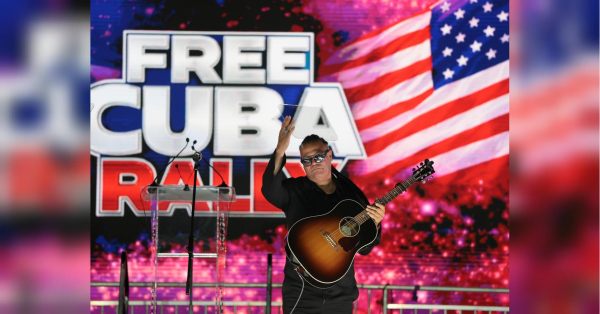
Florida’s politically powerful Cuban American community is pressuring President Donald Trump to completely remove Cuba’s communist leadership, as the Trump administration appears willing to settle for less. Cuban opposition activists, particularly in South Florida, have been publicly expressing their uncompromising message for months. This has included everything from holding prayers to motorcades through the streets of Miami and signing a document — a roadmap called the “Freedom Agreement.” It has solidified their hopes for a transition to democracy. Working groups from South Florida and Cuba have been meeting for weeks to outline plans for after regime change, including holding free and fair elections.
VIDEO OF THE DAY
“The moves point to growing tensions between the Republican-leaning Cuban diaspora in South Florida and the Trump administration, which is sending mixed signals about its true intentions toward the island nation — differences that could affect this year’s crucial midterm elections,” Politico writes.
The administration has imposed an energy embargo on Cuba and expanded sanctions on the island while negotiating with the regime. But Trump and other administration officials have stressed that some kind of deal on economic reforms could satisfy them for now. Among them is Secretary of State Marco Rubio, the son of Cuban immigrants who has long sought to overthrow the leadership in Havana. While administration officials have also said that some senior Cuban officials will have to resign, the overall message they have sent is that full-blown regime change may have to wait.
This approach worries some in the Cuban diaspora, who argue that a U.S.-Cuba deal that prioritizes economic change will fail, given the rampant corruption in Cuba fueled by the regime.
ADVERTISING
Republican Senator Ileana Garcia warned that “if the US does not take military action, otherwise intervene, or have a plan for ‘regime overthrow’ in Cuba, Trump’s future presidential library, planned for downtown Miami, will be seen as an ‘eyesore’ next to the Freedom Tower, which was once a processing center for Cuban refugees,” the article says.
Garcia warned that inaction on Cuba would definitely affect how people in South Florida vote, “especially after years of rhetoric and promises” to remove the communist regime.
Trump's approach to foreign policy has generally prioritized U.S. economic interests over human rights and democracy. The January abduction of Venezuela's autocratic leader, Nicolás Maduro, left much of the Caracas regime in exchange for economic cooperation with the United States. Trump has also backed away from earlier calls for full regime change in Iran, despite initially saying he wanted to help Iranians rise up against their oppressive rulers.
ADVERTISING
Similar results in Cuba are unlikely to satisfy the Cuban diaspora. An April poll of Cuban exiles for the Miami Herald found that 78 percent said they would be dissatisfied with economic reforms alone. It also found that a large majority would support military intervention.
Many Cuban Americans were thrilled that Trump appointed Rubio as his top diplomat, and they trust him as a key player in negotiations on Cuba. But the broader Cuban diaspora has also been caught up in Trump’s immigration crackdown. Cubans have long had a fast-track path to green cards under the Cuban Status Adjustment Act, but the Trump administration has slowed the processing of Cuban applications for legal immigration while stepping up deportations and other enforcement actions against Cubans who have arrived in recent years.
Rubio has publicly sent mixed signals about what he would like to see in Cuba, speaking of the need for both economic and political change. On Fox and Friends, Rubio said that “serious economic reforms” are impossible “with these people in power.”
But the comment could be interpreted as a replacement of a few Cuban officials, rather than a full-blown regime change followed by democratic elections. That would be consistent with Trump’s repeated claims that he has achieved “regime change” in Iran, despite only physically removing most of the top leadership. The economic changes the U.S. is pushing for in Cuba include privatizing state-owned enterprises, allowing more foreign investment, giving Cuban citizens better access to the Internet and requiring Cubans to buy U.S. energy, according to a person familiar with the Trump team’s thinking.
ADVERTISING
“However, the official downplayed the possibility of mass protests, noting past security measures that would likely have prevented Cubans from taking to the streets in large numbers. The Cuban Embassy in Washington declined to comment. While diaspora leaders are eager to free Cuba from communist rule, they say they are willing to be patient to get the policy right,” Politico summarizes.
“There’s a real sense of optimism and hope that we can see change in Cuba,” said Rep. Mike Redondo of Miami, a son of Cuban immigrants . “The Cuban diaspora has failed in the past. I would call it a cautious optimism, but it’s certainly the strongest I’ve had in my life.”
Well, for now, as previously reported, Trump threatened Iran with new strikes if it “behaves inappropriately.”
In the photo in the header: Cuban-American community in South Florida for a free Cuba. Photo by Getty Images