
For most Americans and Europeans living today, a world of anarchy has probably never felt entirely real. Since 1945, the United States and its allies have created and maintained an order that, while not entirely liberal or fully international, has established rules that have maintained peace among the great powers, fostered a world of relatively open trade, and international cooperation. In the decades that followed, the world has become more stable and prosperous. But before this long peace among the great powers, anarchy was far from an abstraction.
VIDEO OF THE DAY
At that time, countries were just beginning to project military power beyond their borders, and information, goods, and people moved more slowly. Even in times of international unrest, states could only cause each other a certain amount of “trouble” without risking their own demise, according to an article by international affairs professor Daniel Dresner and political science professor Elizabeth Saunders for Foreign Affairs, the most influential American journal on international relations and foreign policy.
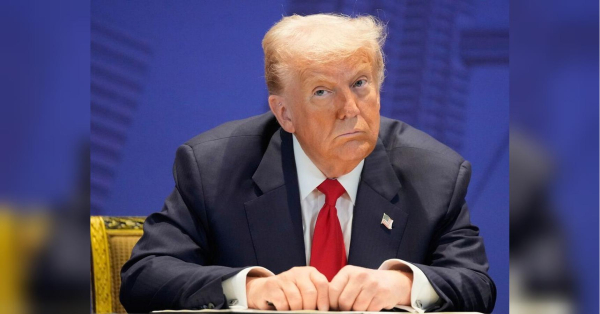
Today, the most powerful country in the world is leading the world into a different kind of anarchy. Trump’s drive for territorial expansion is undermining the most powerful norm since 1945: that borders cannot be redrawn by force of arms. And his disregard for domestic institutions has allowed him to brutally suppress any attempts within the United States to curb these expansionist dreams.
In other words, the anarchy that emerges under Trump is more chaotic. It is closer to the more primitive anarchy of the political philosopher Thomas Hobbes—a world of “all against all,” where sovereign power cannot be challenged domestically or internationally. In this Hobbesian order, led by a leader who rejects any constraints on his ability to act and whose technology inspires him to move at breakneck speed, anything goes. Order may well eventually emerge from this anarchy, but that order is unlikely to be led by or benefit the United States.
ADVERTISING
In a world of anarchy, war is a normal part of international relations, the article says. Anarchy also functions as a powerful constraint, forcing states to act prudently and use their resources economically. The risk of war can make even great powers think twice before taking aggressive action, to avoid creating a balancing coalition.
One of the best-known theories about how order emerges from anarchy is the “hegemonic stability theory,” or the idea that the international system is more stable when one country dominates.
Many observers believed that the Trump administration was reorienting itself toward China, including by withdrawing resources from Europe and the Middle East. Although Trump did not inherit a peaceful international environment, he still had time to act: even despite wars in Ukraine, Gaza, and Sudan, no global wars had broken out, and Washington had partners in Europe who helped stop revisionist Russia from conquering Ukraine after its full-scale invasion in 2022. The United States still had a powerful network of allies, a competent and extensive diplomatic apparatus, and the most powerful scientific and technological base in the world.
ADVERTISING
But in one year, Trump has dismantled most of these advantages, stripping or abandoning them despite their value to the United States in the struggle for great-power dominance. Instead, he has embraced resource extraction, corruption, and transactional arrangements that he can review at will.
Over the past year, Trump has dismantled efforts to preserve what remains of the US-led order, engaged in unnecessary and increasingly dangerous clashes with key allies, and undermined the very foundations of US power. Russia’s war in Ukraine, in which Trump seems to have little interest, and competition with China, about which the Trump administration’s latest National Security Strategy is largely silent, pose the most serious threats to the US-led liberal order.
Trump's threats to the sovereignty of Greenland and Denmark, and with them his apparent willingness to undermine NATO, have rightly angered European countries that otherwise seek to allow Washington preferences that most countries could only dream of.
No other hegemon in history has had the power projection capabilities that the United States still possesses, or the speed and reach of communication that the digital age has made possible. Next month, Trump may decide to bomb Iran again—or make a deal with the Iranian clergy to get oil concessions. He may reaffirm America’s commitment to NATO—or invade Greenland. If unpredictability is to have any value as a geopolitical tactic, it must be used strategically and sparingly. Trump’s volatile impulses, which allow him to act faster and more recklessly than any leader in history, represent a new level of chaos.
ADVERTISING
The new Trump anarchy is different in another important respect: no other moment in history has had such a dominant influence, one that had been a consolidated (though never complete) democracy for so long, so quickly begin to retreat and undermine its own democratic institutions.
The foundations of American power are rooted in the rule of law at home and reliable commitments abroad, precisely what Trump is trying to dismantle. His dismantling of foreign aid and the infrastructure of U.S. scientific and technological dominance, his dangerous confrontation with staunch European allies, and, most damagingly, his use of the military and federal security forces to bolster his domestic power will ultimately undermine American power. Alienated allies are already turning to China and each other to defend themselves against an unstable United States. Whether these actions succeed or not, they weaken the United States and make China relatively more attractive to smaller states seeking security. In Trump’s zero-sum global order, it is the United States that will ultimately pay the highest price, the authors explain.
Previously, “FACTS” wrote that because of Trump's flirtation with Putin, the US will have to pay more later, and while Canada is preparing for a guerrilla war, the country has developed a plan in case of a US invasion.