
The blaze originated following a crash with another vessel registered under the Liberian flag.
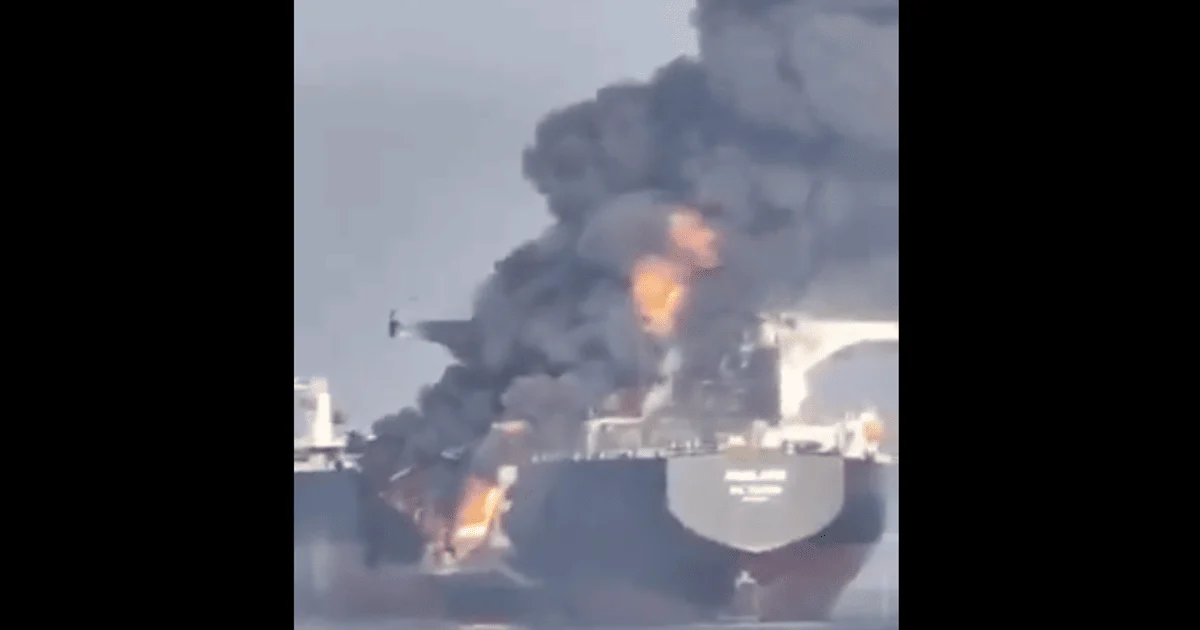
Fire on a tanker of the Russian “shadow fleet” / © screenshot from the video
A petroleum carrier linked to the so-called “shadow fleet” of the Russian Federation has ignited in the Gulf of Oman, situated between Iran and the United Arab Emirates.
Videos documenting the conflagration are being shared on social media platforms.
The Adalynn, facing sanctions imposed by Ukraine, was registered in Antigua and Barbuda and frequently traveled between Ust-Luga, Russia, on the Baltic Sea, and Vadinar, along India’s western coastline.
Per Bloomberg, the blaze resulted from a contact incident with the 335-meter oil vessel Front Eagle, which is under the Liberian flag.
Data from vessel tracking, observed by the publication, indicates that the tankers were navigating in proximity within the Gulf of Oman before their paths intersected. The incident took place approximately 44 kilometers from the harbor of Khawr Fakkan (UAE).
The owner of the vessel Front Eagle characterized the event as “navigational” and “unconnected to the present regional dispute.”
Concurrently, the publication highlights that the Iranian Navy has cautioned about escalating jamming of ships' electronic systems. According to multiple owners, this activity is compelling crews to enhance visual monitoring and rely more on conventional methods, like physical navigational maps.
As per ship tracking information, the Front Eagle likely experienced signal interference while passing the Iranian port of Assaluyeh on June 15 and 16, despite being considerably removed from where the incident occurred. Tracking data reveals that the supertanker was en route to China from the Iraqi oil terminal at Basra.
The British maritime safety firm Vanguard Tech reported that the flames were extinguished, and the vessel personnel were unharmed.
An entry on social media by the UAE National Guard states that 24 members of the Adalynn’s crew have been rescued. Frontline also verified the safety of its crew members.
The marine areas surrounding the Straits of Khor Fakkan and Hormuz (UAE) encounter heavy traffic as key access points for major crude oil and fuel providers in the region, notably Saudi Arabia, Iraq, Iran, and Abu Dhabi.
It is worth noting that Iran previously threatened to obstruct the Strait of Hormuz, a crucial global route for the transportation of petroleum and liquefied natural gas.
Source: tsn.ua