

AI assistants for software developers have gone from a fashion trend to a real business tool, but instead of loud promises of a CEO revolution, a clear economic model for implementation is needed. Oleksiy Vygodsky, Head of Enterprise Applications and Technologies at MODUS X, explains why Coding Time is becoming the new KPI for software teams and how even a 10% increase in productivity can determine the winner in the market
Buy an annual subscription to six Forbes Ukraine magazines for the price of four issues. If you value the quality, depth, and power of real-world experience, this subscription is for you.
AI promises a revolution in IT, but instead of loud slogans, CEOs and CFOs want to see specifics. Not “+50% productivity”, but how many man-days the team will actually save from implementing AI technology. How will this affect the cost of the product, how many months will the investment pay off.
In this column, I explain how to calculate the economic model of implementing AI in software teams and why even a few percent increase becomes crucial for business.

Popular Category Money Date Yesterday Crypto is one step closer to legalization. Deputies supported the bill on virtual assets in the first reading. When can the second reading take place and what will legalization change for the crypto industry?
The illusion of instant revolution
AI-powered enterprise development tools like GitHub Copilot, Tabnine, and Codeium are marketed as a “revolution,” but the reality is more nuanced: a 12–25% productivity boost, according to an MIT study. That may sound modest, but even 10% is an extra month of work per developer per year. For large companies, that’s hundreds of thousands of man-hours and the opportunity to be first to market.
The Magic of Coding Time: A Hidden ROI Lever
The key indicator is Coding Time. This is the time that a developer spends writing code. In reality, it is 15–40% of 100%, according to the Global Code Time Report, and in some companies it is even an hour of time (12.5%). The rest of the time is spent on meetings, testing and documentation. Therefore, if AI speeds up the writing of code, for example by 15%, the actual increase in productivity of the entire team is about 4.5%. This can be calculated using the formula:
Net Effect = Coding Time × AI Boost
If Coding Time = 30% and AI Boost = 15%, then Net Effect = 0.3 × 0.15 = 4.5%
Coding Time is a parameter that a company can influence independently. It is reduced by multi-level processes of requirements and interface form approval, bureaucracy, excessive number of meetings instead of asynchronous updates, waiting for task statements and code reviews.
Most of the time cannot be “saved” all at once. Live engineering expertise remains necessary, and AI currently acts as an assistant that reduces routine but does not make key decisions.
Increase Coding Time and enhance the effect of AI
Discuss with your IT director what you need to:
- automate code reviews to reduce time spent on routine reviews;
- reduce the number of rallies to those strictly necessary;
- use AI not only for writing code, but also for testing, documentation, and routine operations;
- Clearly formulate tasks to minimize time spent clarifying and changing requirements.
Cornell University research shows that with Copilot, tasks are completed 35% faster, manual coding is reduced by 11%, and information retrieval is reduced by 12%.
I advise you to calculate the economic model for implementing AI as follows:
1. Cost of an hour of team work:
Cost/hour = (Annual salary × # of developers)/(Annual hours × # of developers)
2. Time saving:
TimeSaved = Annual Hours × Coding Time × AI Boost × # of Developers
3. Saving money:
Savings = TimeSaved × Cost/hour
4. Net effect taking into account licenses and implementation:
Net=Savings − (License Cost + Implementation Cost)
Example: a team of 10 developers with a salary of $60,000 per year each, a workload of 1920 hours per year, a GitHub Copilot license costs $26 per month per developer. The calculation using this model shows savings for the company of about $86,880 per year – that’s almost one and a half years of salary per developer or the ability to accelerate the launch of a new product by several months. In competitive industries, this can be a decisive factor.
Why even a small percentage is strategically important
In aviation, reducing the weight of an aircraft by 1% saves millions of dollars every year. In retail, reducing inventory turnover by one day frees up significant resources. In Formula 1, 0.2 seconds per lap decide the championship. In development, an additional 5–10% of speed is months that can be won in the market, accelerate hypothesis testing, and quickly change strategy.
In large companies with thousands of developers, a 5% increase is a hundred times more impactful than in a small team. Imagine the scale of the impact for companies like Accenture or TCS, where the development staff is over 100,000 professionals.
AI removes some of the routine, accelerating the creation of typical code, suggests solutions, but does not replace experience. When planning, it is worth considering:
- Coding Time share – without it, the effect is reduced by 2–4 times;
- quality and competent integration of AI tools;
- the level of experience of the team – junior developers win more, senior developers win less, but also save on routine;
- the nature of tasks – template tasks are completed faster, architectural and research tasks are more difficult;
- business utilization and the impact of meetings, training and adjustments on real working time;
- the strategic importance of implementing AI to maintain flexibility and competitiveness;
- how the freed time will be used: for training, R&D, experiments, or staff optimization.
AI – scaling the best competencies, not replacing people
The AI effect increases competitiveness, quality, and sustainability of processes. Accelerating code writing is only part of the process. The team includes analysts, QA, DevOps, and managers, whose workflows benefit in different ways.
Below is how AI saves them time and resources:
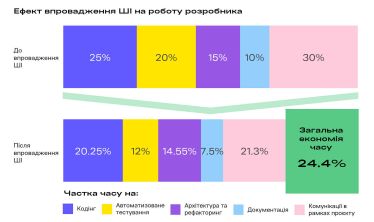
The effect of implementing AI on developer work. Time proportion is a typical distribution of developer tasks, which is relevant for outsourcing companies (Accenture, TCS, EPAM), where the percentage of time spent on coding is higher than in product companies (Google, Amazon, Meta). Efficiency gain – according to MIT research.
Such an increase means:
- faster product launch;
- the ability to gain audience share more quickly;
- reducing the number of errors and reputational risks;
- process stability and reduced dependence on “star” specialists.
AI is a powerful multiplier that will only work where the right infrastructure is in place. It will not replace talented people, but it will make their work more efficient and businesses more mobile if:
- increase Coding Time;
- gradually expand the application of AI to different stages of development;
- understand that not all tasks convert into direct savings, but affect the speed and quality of business.
In addition, AI is able to help not only at the stage of writing code, but also in related tasks:
- transform unstructured business requirements into understandable technical criteria and user stories;
- assist in the analysis of complex and new modules, identifying dependencies;
- automatically generate test cases and suggest fixes;
- keep documentation up to date;
- in the future – to offer architectural schemes, diagrams, API contracts.
Even a modest increase of 15–25 minutes per day is an extra work week per year and a motivated team.
Not a magic wand
AI is not about instant and obvious ROI, but about strategic flexibility and survival in the era of digital transformation and fierce competition. Businesses gain not just flexibility, but agility – the ability to quickly reorient resources and processes and respond to changes. Even 10% of time saved in a team of 100,000 developers is 10,000 FTEs that can be directed to new projects or to advanced training, training to increase AI Boost and reinvest time in development.
But it’s dangerous to view freeing up resources as an excuse to cut staff – it will limit growth and innovation. AI is not about cutting costs directly. It’s a mechanism for exponential growth when built into a company’s strategy, processes and culture.
In business, like in racing, it’s not the one with the most powerful engine that wins, but the one who can take the corners faster. AI enables business to take those corners faster, but only if you control not just the power, but the entire track. In today’s world, even a 10% boost can determine who comes out on top.