
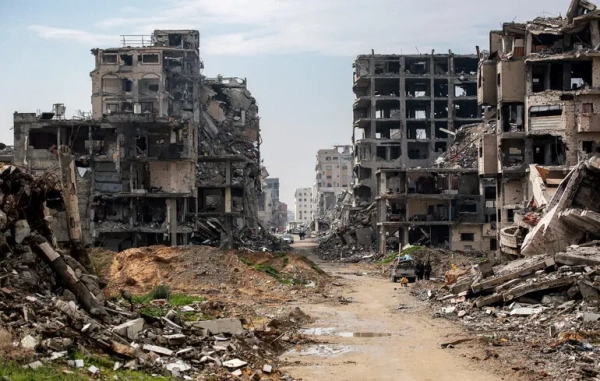
© Getty Images The US plans to build “smart cities” in Gaza based on artificial intelligence and a manufacturing center named after Elon Musk.
Donald Trump is proposing a post-war reconstruction plan for Gaza that aims to realize his vision of a “Gaza Riviera” — through mass relocation, artificial intelligence and at least a decade of US administration of the war-torn enclave, CNBC News reports.
The plan, outlined in a 38-page document first reported by the Washington Post and reportedly under consideration by the Trump administration, calls for the “voluntary” resettlement of Gazans in exchange for digital tokens, the creation of six to eight “AI-powered smart cities” and the construction of a manufacturing hub named after Elon Musk.
The document also provides for the resettlement of the entire population of Gaza (over two million people) — at least temporarily: either by leaving for other countries, or by moving to temporary residential areas inside the enclave for the duration of reconstruction.
According to the Washington Post, the plan was developed by the same Israelis behind the controversial US-Israeli-funded Gaza Humanitarian Fund (GHF). Officially, it is supposed to provide food for the enclave’s residents, but UN experts have sharply criticized it for being used for covert military and geopolitical purposes, in flagrant violation of international law.
According to the plan, Gaza would be under US care for about a decade — “until a reformed and deradicalized Palestinian Authority is ready to take over.” The document, called the Gaza Reconstitution, Economic Acceleration and Transformation Trust (GREAT Trust), promises to transform the blockaded enclave, where more than 60,000 Palestinians have died since October 7, 2023, into a luxury tourist resort and technology hub.
“The reconstruction will increase the value of Gaza by approximately $324 billion and dramatically improve the quality of life,” the document states. The GREAT Trust is to be launched on the basis of an initial bilateral agreement between the United States and Israel, with the latter retaining “general rights to meet its security needs.”
The plan’s authors argue that federal funds or donations will not be needed: funding should be provided by the private and public sectors through “megaprojects” – from data centers and electric car factories to luxury apartments and coastal resorts.
The document states that approximately 30% of Gaza’s state-owned land will be leased to the GREAT Trust for up to 99 years. This, together with investments, would create an initial capital of $300 billion with “self-sustaining revenue streams.”
Those who agree to leave Gaza for another country will receive a package of $5,000, four years of rental subsidies, and one year of food subsidies. The plan assumes that 25% of the enclave’s residents will agree to leave, and 75% of them will not want to return.
The authors claim that this approach would save $23,000 per resettler compared to the cost of supporting those who remain in Gaza. However, the document makes no mention of international law, Palestinian resistance to forced resettlement, or the position of Arab states, which have been demanding for decades for Palestinians to establish their own state and self-determination.
The plan’s “ultimate goal” is “self-government for Gaza within the framework of the Abraham Accords,” a framework agreement that normalizes diplomatic relations with Israel. However, the creation of an officially recognized Palestinian state is not mentioned.
Gazans who leave their land plots would receive “digital tokens” from the GREAT Trust in exchange for the right to develop their property, with the option to exchange the tokens for ownership of reconstructed housing in the future.
Donald Trump first floated the idea of a US-run “Gaza Riviera” in February, sparking outrage among international leaders and especially Middle Eastern allies Saudi Arabia, Jordan and the UAE. Human rights groups have accused Israel of ethnic cleansing and genocide in Gaza, which Israel strongly denies. At the same time, Prime Minister Benjamin Netanyahu has supported Trump’s idea.
According to the UN, as of April, about 92% of all residential buildings in Gaza had been damaged or destroyed since the start of the war, which broke out after the Hamas group attacked Israeli territory on October 7, 2023. About 1,200 people were killed then.
Hamas on Monday strongly rejected the proposed plan. Bassem Naim, a member of the movement’s political bureau, said: “Gaza is not for sale” and is “part of the greater Palestinian homeland.”