
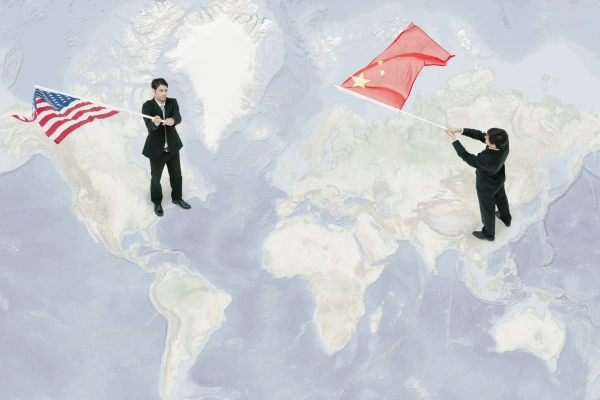
© Getty Images China offers Africa something the US no longer gives.
Since Donald Trump’s return to the White House, bringing with him an extensive catalog of fresh levies, African nations have encountered increased challenges in exporting their commodities to the United States. This situation has presented a fresh prospect for China, according to The Wall Street Journal.
Since May 1, Beijing has scrapped import duties on all products from 53 out of 54 African countries, aiming to invigorate commercial relationships and enhance influence on the continent. Now, a variety of goods, ranging from wine to sesame seeds and wool, enter China from these countries without tariffs, with the exception of Eswatini, which maintains diplomatic ties with Taiwan.
Experts suggest this action could further pull Africa, possessing over a billion inhabitants and substantial mineral wealth, into China’s zone of authority.
Already Africa’s foremost trade associate, China is leveraging this novel approach to reinforce its standing as a champion of developing nations. Many African leaders and populations embrace Beijing’s discourse, perceiving China as a success story in elevating hundreds of millions from poverty.
“From a political point of view, this decision seems very successful,” said Ronak Gopaldas, director of the African consulting company Signal Risk.
“This reinforces Beijing’s image as a stable and reliable partner for Africa, especially against the backdrop of Washington’s more chaotic and pragmatic stance in recent years.”
This new system might aid China in securing stocks of vital minerals such as cobalt, copper, and coltan. It also unlocks fresh avenues for Chinese enterprises to collaborate with African governments on projects related to infrastructure, logistics, and manufacturing, all requiring Chinese financial assistance.
Kenyan Vice President Kiture Kindiki announced at a Nairobi business gathering in March that the zero-tariff arrangement provides Kenya an opportunity to narrow its trade imbalance with China, currently around $4 billion.
He identified coffee, tea, macadamia nuts, and avocados among the items poised to gain from the updated regulations.
Nonetheless, specialists caution that, initially, this new strategy is unlikely to fundamentally alter the trade dynamics between Africa and China, which predominantly revolves around the export of African resources to China and the import of Chinese manufactured goods to Africa.
Kobus van Staden, director of research at the China-Global South Project, stated that the initiative “does not address the numerous non-tariff barriers” that hinder trade between Africa and China.
Among these, he emphasized China’s stringent sanitary and safety standards for agricultural exports, alongside the underdeveloped logistics and transport infrastructure present in several African nations.
Despite the new rules enhancing product competitiveness within the Chinese market, Nigerian firms also voice concerns regarding elevated production expenses, shaky infrastructure, and logistical challenges.
As one of the least developed nations, Lesotho gained duty-free entry to the Chinese market toward the close of 2024.
However, Mokheti Shelile, the nation’s former Trade Minister, noted that Lesotho requires investment in production capabilities, domestic processing of commodities, logistics, and export assistance to fully capitalize on the new pact.
“If Lesotho can do this, the Chinese market will become a powerful engine of economic growth. If not, the benefits will remain limited and concentrated only on raw material exports,” said Chelilie.
Beijing’s endeavor presents a sharp contrast to the Trump administration’s tactics.
Last year, the US levied uniform tariffs of 30% on South Africa and 15% on the resource-abundant Democratic Republic of Congo. Subsequently, Trump enforced a blanket 10% tariff on all countries, although the legality of these decisions is presently under judicial review.
Trump, who publicly disparaged Lesotho as a country “nobody has ever heard of,” last year threatened it with 50% tariffs — among the highest on any single country or territory. That hit the country’s textile industry hard.
The US president also accused Nigeria of failing to stop the “genocide of Christians” by Islamist militants, and the South African government of allegedly committing “genocide” against the country’s white minority.
Since commencing his second term, Trump has terminated USAID, an agency that served as a principal American actor in Africa for decades. Concurrently, the fate of President Clinton’s African Growth and Opportunity Act, which granted duty-free entry to the American market for specific goods from African countries, remains ambiguous.
Trump administration to destroy nearly $10 million worth of contraceptives
Additionally, the Trump administration has left a significant number of American ambassadorial roles in Africa unfilled.
Beijing’s fresh duty-free initiative might enable it to partially recover ground ceded in recent years on the continent.
China has been lending heavily to Africa for decades, mostly to finance ports, airports, railways and other infrastructure built by Chinese companies. According to researchers at Boston University, Chinese loan commitments to Africa reached an estimated $181 billion between 2000 and 2024.
Yet, China has repeatedly faced censure over the subpar quality of certain projects and demanding lending terms. Amid the economic deceleration, Beijing has curtailed funding for Africa, rendering the updated duty-free access policy a substitute avenue for expanding economic sway.
Simultaneously, it can empower China’s African counterparts to fortify their own economies — provided they can master the art of creating added value from their native raw materials and agricultural produce, and generate commodities capable of yielding greater profits.