
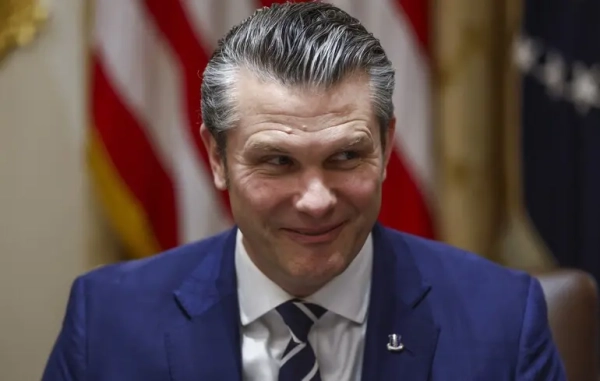
© EPA/WILL OLIVER The Pentagon has presented Europe with a reality.
The abrupt choice by US Secretary of War Pete Hegseth to call off the dispatch of 4,000 American soldiers to Poland took Pentagon authorities and European partners by complete surprise, Politico indicates.
The justifications behind this verdict are still unclear – this data was conveyed to the news outlet by three officials from the US Department of Defense with firsthand knowledge of the circumstance.
US President Donald Trump has voiced his displeasure with European allies repeatedly, citing what he perceives as inadequate backing in the struggle against Iran.
Yet, Trump had earlier referred to Poland as a “model ally” due to the nation’s substantial expenditure on defense.
The determination appeared all the more unanticipated since some of the personnel and materiel had already begun to arrive in Poland.
This occurrence has ignited renewed apprehension in both European capitals and within the Pentagon regarding the potential for such actions to incite more forceful actions from Russia — and the question of which allied nation might become the subsequent objective.
“We were entirely unaware this was imminent,” confessed one US official.
As per his account, in the prior 24 hours, American and European officials have been endeavoring to ascertain the rationale behind the resolution via telephone and to evaluate whether new unforeseen measures are being formulated.
This resolution followed Hegseth’s prior announcement concerning the removal of 5,000 American personnel from bases stationed in Germany.
However, regarding Germany, Trump had earlier issued public warnings about diminishing the military footprint subsequent to remarks made by German Chancellor Friedrich Merz, asserting that the US was “belittling itself” in the dispute with Iran.
Four thousand soldiers originating from Texas were primed for a long-scheduled nine-month rotation in Poland, encompassing joint exercises with NATO allies, when the order to nullify the deployment materialized.
The report underlines that the cancellation of a routine assignment of this nature is notably unusual, given that American troops in Europe are perceived as a vital component in deterring Russian aggression.
Trump has reiterated his stance that Europe ought to depend more on its own resources, and this recent determination has only served to bolster the notion that Washington is sincere about curtailing its military involvement on the continent.
Previous commander of the US Army in Europe, Lieutenant General Ben Hodges, affirmed that the US Army’s function in Europe entails deterring Russia, protecting US strategic imperatives, and offering assistance to allies.
“And presently, a pivotal aspect of that deterrent has simply been eliminated,” he remarked.
The Pentagon, conversely, maintains that the verdict was carefully considered.
Acting US Defense Department spokesperson Joel Valdez declared that the resolution was adopted subsequent to a “thorough, multi-layered process” encompassing US European Command and other entities.
“This was by no means an impulsive, last-minute decision,” he asserted.
The White House offered no comment.
Nevertheless, the overarching US strategy for Europe continues to be uncertain. As indicated by a pair of US officials, the procedure of withdrawing troops from Germany is still in the planning phases.
Despite the fact that this represents merely a portion of the approximately 38,000 American personnel in Germany, European allies are already interpreting this as a signal: there will be ramifications for openly disagreeing with the White House.
“The Polish government never took aim at President Trump and have traditionally carried out all the actions expected of trusted allies. In spite of all that, this transpired,” Hodges stated.
Polish officials, via social media, either stood up for the US decision or voiced worries over what it might mean for the Alliance. Certain individuals articulated aspirations that the US might substitute the rotational presence with a long-term establishment.
Polish Deputy Prime Minister Wladyslaw Kosińska-Kamyś stated that the decision “does not directly affect Poland” and is linked to the previously disclosed assessment of American military deployment in Europe.
A majority of Polish citizens are in favor of the proposition of a permanent American base within their country, and Poland’s defense budget is projected to rise to 4.7% of GDP in the current year, the highest proportion among NATO members.
The Pentagon recently finalized a worldwide review of the US military’s footprint across the globe, even though there are no intentions to disseminate this document.
According to authorities, it does not foresee an extensive removal of personnel from Europe.
Nonetheless, another strategic document — the US National Defense Strategy — clearly contemplates shifting greater military resources to distinct regions and allocating increased security obligations to the Europeans.
In October, the Pentagon had already declared that it would not replace the American brigade that departed Romania at the close of the prior year, a move that triggered discontent among advocates of a robust defense policy within the US Congress.
Former Finnish official Joel Linnainmäki commented that this introduces a “notable concern for European security” and radically alters the distribution of responsibility between the US and the Europeans.
Concurrently, certain NATO representatives endeavored to diminish the ramifications of the decision.
A high-ranking Alliance official asserted that rotational forces mirroring the US brigade in Poland are not integral to NATO’s sustained plans to deter Russia.
According to him, the US is actively re-evaluating its military deployment in Europe, but concurrently, Canada and Germany are actively reinforcing forces on NATO’s eastern flank.
He further mentioned that France and Germany collectively sustain approximately 5,000 personnel on the Alliance’s eastern flank currently, and it is expected that this figure will augment by several thousand before the close of the following year.