
In a recent investigation, experts have identified helium isotopes that represent a preliminary indication of dynamic tectonic fracturing—a further separation on the globe.
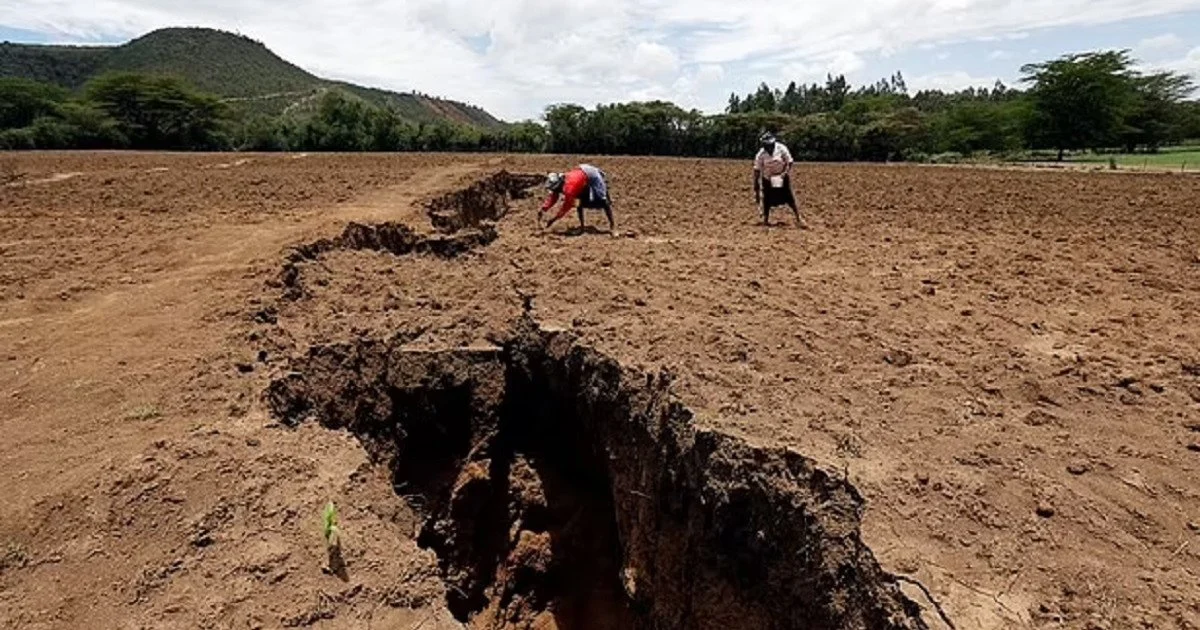
The Earth's crust in East Africa is rapidly thinning / © Reuters
A global group of earth scientists, spearheaded by Oxford University, has observed concerning signals implying that the African continent might be in the initial phases of a tectonic separation.
The research, documented in the publication Frontiers in Earth Science, centers on the Kafue Rift zone in Zambia.
Through the analysis of gases discharged from thermal springs, the investigators discovered distinctive isotopes of helium originating from mantle strata at depths spanning 40 to 160 kilometers. In conjunction with helium, traces of carbon dioxide of mantle provenance were also registered. These outcomes propose that the Earth’s outer layer in this locale is starting to expand and diminish, paving the way for liquids from the planet’s interior.
The Kafue Rift constitutes a segment of a vast fault arrangement approximately 2,500 kilometers in extent, traversing diagonally across the heart of Africa. Scientists posit that this fissure could ultimately evolve into a fresh tectonic plate frontier, analogous to the East African Rift. Should this development persist, it would culminate in the fragmentation of sub-Saharan Africa into individual landmasses, albeit such a prospect would necessitate millions of years.
According to geologist Mike Daly from the University of Oxford, thermal springs alongside the Kafue Rift in Zambia exhibit a helium isotopic configuration that suggests a straightforward linkage of the springs to the Earth’s mantle, situated at a range of 40 to 160 kilometers underneath the surface. This association with the fluid denotes the activity of the Kafue Rift boundary, and consequently, of the Southwest African Rift Zone. The researchers inferred that they had perceived preliminary indications of the disintegration of sub-Saharan Africa.
Keep in mind that based on a recent investigation executed utilizing GPS data, the terrain of South Africa consistently elevated above sea level between 2012 and 2020, with drought potentially serving as a significant element in this phenomenon.
Comments Sort: New Old Popular Submit
Source: tsn.ua