
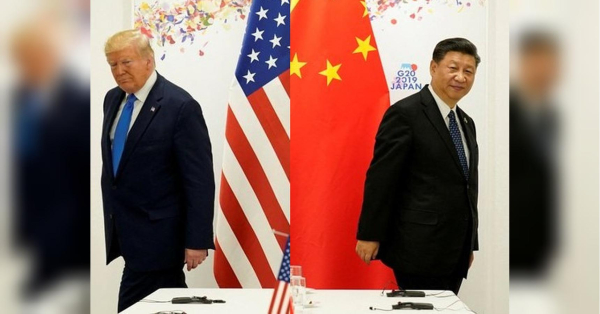
As President Donald Trump and Chinese leader Xi Jinping prepare to meet, the United States is stuck in an uncertain ceasefire with Iran. Beijing has watched as Washington failed to break the Iranian blockade and has squandered significant firepower while global oil prices have soared. Pentagon strategy documents show that containing Beijing is no longer a priority for the Trump administration. And with frustrated allies refusing to help and the war creating political problems for Trump at home, current and former senior American officials fear that China is coming to the summit with “the cards in its hands.”
VIDEO OF THE DAY
The meeting between the two leaders comes two months after Trump postponed it, citing the need to focus on the then-“newborn” war. But the U.S. military campaign appears to have shifted from a desire to destroy Iran’s nuclear programs to a tangled, protracted conflict centered on who controls the Strait of Hormuz, through which about 20 percent of the world’s oil supplies pass.
“The Chinese military is closely studying our operations against Iran to identify vulnerabilities that they could exploit in a conflict with the United States,” a defense official said on condition of anonymity.
The official said China is watching how American military commanders plan operations and execute their plans, down to the pace of missile strikes and intelligence gathering.
ADVERTISING
“The United States military has more than enough ammunition and supplies to serve all of President Trump’s strategic objectives and beyond, and Operation Epic Fury exposed what happens when you interfere in the affairs of the United States,” said White House spokeswoman Anna Kelly.
But Beijing, which is rapidly building up its arsenal of long-range missiles and drones, has almost certainly noticed that the US is trying in vain to reopen the strait or to stop Iranian attacks on US and allied ships throughout the region. The redeployment of ships, air defenses and troops from the Pacific to the Middle East is also a sign that the US arsenal is not limitless.
“Without a clear policy, a strategy, we are suffering at the operational level of warfare,” said a defense official. “The most important question to answer is whether this is a problem exclusively with the current administration or whether it is broader in American warfare.”
ADVERTISING
US defense officials have publicly insisted that the relocated assets, which include an aircraft carrier strike group and several Navy ships carrying 2,500 Marines, have not reduced US combat readiness in the Pacific, Politico reported.
“I don’t see any real effort to strengthen our ability to deter China,” Admiral Samuel Paparo, who leads the military group overseeing the Pacific, told lawmakers in April.
He added that the operational and combat experience gained by the crews of American ships will prove invaluable, especially compared to Chinese forces, which have less experience in defense.
Although Chinese forces are far more advanced than Iran's, Tehran has proven its particular prowess in using cheap, one-way strike drones to carry out large-scale attacks and overcome some air defense systems.
ADVERTISING
China's missile arsenal is certainly much larger than Iran's, so “they could treat some of their missiles the same way Iran treated its drones,” said Becca Wasser, a defense strategy expert who served on the congressionally appointed National Defense Strategy Commission.
Beijing has its own problems. China has not been at war since the 1979 invasion of Vietnam and is in the midst of a major military purge that recently saw two former defense ministers, Li Shangfu and Wei Fenghe, sentenced to death. Experts estimate that more than 100 senior military officers have been dismissed since 2022 as a result of the crackdown.
But just as the United States has watched Beijing’s military buildup, the Chinese government has been closely monitoring U.S. forces, including Operation Desert Storm, the first U.S. use of precision-guided munitions. China began launching its first aircraft carriers after the 2008 global financial crisis and has invested heavily in long-range missiles to keep the U.S. military at bay.
And China is certainly also watching how quickly America is expending its high-quality missiles, from Tomahawks to Patriot air defense systems, in the Middle East war.
We should add that the fact that Trump is preparing a sharp turn in relations with China has caused a split among his advisors and the American business elite.
Collage of “FACTS”