
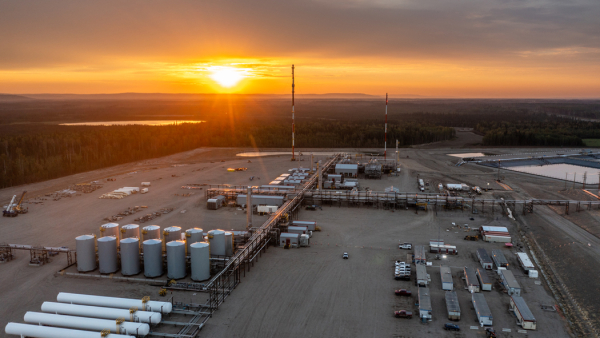
The British energy conglomerate Shell has reached an agreement to acquire ARC Resources of Canada in a transaction valued at $16.4 billion , encompassing debt, representing Shell’s most substantial acquisition since its procurement of the energy giant BG Group in 2016, as reported by Reuters.
This transaction will enable Shell to augment its output by 370,000 barrels of oil equivalent per day , elevating it from the existing level of approximately 2.8 million barrels of oil equivalent per day . For the corporation, it constitutes a pivotal maneuver amid an anticipated decline in yield from established reserves and the necessity for novel discoveries or a major merger and acquisition event.
ARC Resources possesses a production foundation proximate to Shell’s Canadian holdings tied to the LNG Canada venture. Shell controls 40% ownership in this LNG project, which holds a tactical edge owing to its capacity to furnish liquefied natural gas to Asian clientele with greater expediency compared to numerous other LNG endeavors in North America.
ARC’s output comprises roughly 60% natural gas and 40% liquid petroleum products , aligning with Shell’s scheme to reinforce its gas assets and LNG operations.
As per the agreement stipulations, Shell will tender to ARC stakeholders C$8.20 in cash and 0.40247 Shell shares for each ARC share . The remuneration arrangement is structured as about 25% in cash and 75% in stock , signifying a premium of around 20% relative to ARC’s average share value over the preceding 30 days.
Shell will additionally take on roughly $2.8 billion of ARC’s net debt and lease commitments , establishing the transaction’s enterprise worth at approximately $16.4 billion . The equity valuation is assessed at $13.6 billion , of which $3.4 billion will be funded through cash resources and $10.2 billion via Shell equity.
This acquisition will contribute around 2 billion barrels of proven reserves to Shell’s portfolio, with the company estimating it will yield approximately $250 million in synergies within one year of finalization. Shell further anticipates that the ARC resources will produce roughly $1.5 billion in free cash flow annually .
The firm underscores that the accord does not modify its capital expenditure budget of $20–22 billion through 2028. Shell has also reaffirmed its aim to allocate 40–50% of operational cash flow towards shareholder compensation.
In the aftermath of the deal’s disclosure, Shell elevated its objective for average annual output expansion for the ongoing decade from 1% to 4% in contrast to the 2025 benchmarks. Moreover, the enterprise intends to sustain liquid hydrocarbon manufacturing at nearly 1.4 million barrels per day extending through 2030 and beyond.
Upon the pronouncement, ARC Resources’ shares increased by over 22% on the Toronto Stock Exchange, while Shell’s shares decreased by about 2% . This reflects a favorable investor response from ARC stakeholders to the deal’s premium, coupled with a more tempered market perspective concerning Shell’s escalating debt burden.
For the worldwide energy landscape, the Shell–ARC transaction serves as another indication of heightened large-scale mergers and acquisitions within the oil and gas domain, wherein entities endeavor to replenish depleted fields, broaden their resource foundation, and solidify their standing in both the gas and LNG sectors.