
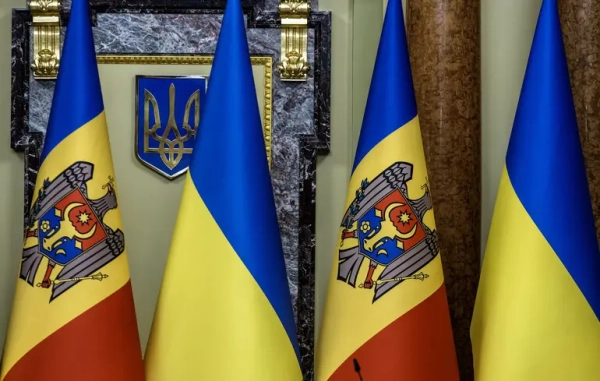
© depositphoto/Wlad_Mus Ukraine has the potential to progress toward joining the EU.
As reported by Politico, Ukraine and Moldova might make headway in their applications to become members of the European Union following the electoral setback of Hungarian Prime Minister Viktor Orban, potentially bringing to a close a four-year impasse concerning their applications.
While these nations obtained candidate status in 2022, their journey toward membership faced obstacles because of Orbán's obstruction, who used his veto against the initiation of negotiation clusters, which are sets of reforms and commitments that candidates must fulfill before accession.
According to insights from four diplomats and EU officials familiar with the discussions, these dialogues could commence in the near future.
European Council President António Costa stated, prior to the EU leaders' summit in Cyprus following a meeting with Ukrainian President Volodymyr Zelensky, that now that the EU has managed to release a €90 billion loan for Ukraine, “it is opportune to advance” to the subsequent phase – EU accession.
The initial formal step — the commencement of the first negotiation cluster — has been stymied by Hungary for several years, but might now proceed after the shift in leadership in Budapest.
Deputy Prime Minister Taras Kachka mentioned in a comment to the publication that Ukraine anticipates the clusters to be initiated “in the approaching weeks.”
He also pointed to the May 26 assembly of European affairs ministers as a possible timeframe for the start of the initial cluster. Nevertheless, the official commencement necessitates unanimous endorsement from all 27 EU member states — and up to this point, it is Hungary that has impeded the progression.
Orban is slated to cede authority next month to opposition leader Peter Magyar, who has expressed that while he does not advocate for Ukraine's “expedited accession,” he will not hinder the established procedure.
Typically, this process spans several years and demands extensive overhauls. The most recent EU expansion took place in 2013, with Croatia becoming a member.
Magyar stated that “Budapest will welcome nations that are prepared to join, and will not subject them to delays, as this is not in the best interests of Europeans.”
Kachka indicates that Ukraine has the potential to launch all active negotiation clusters by the EU summit in June. EU Commissioner for Enlargement Marta Cos also mentioned June as a key period for at least the initial cluster.
During the summit in Ayia Napa, Cyprus, Zelensky, Costa, and European Commission President Ursula von der Leyen advocated for “the immediate opening of negotiation clusters.”
The EU has previously voiced apprehensions regarding the battle against corruption in Ukraine, and certain Ukrainian MPs have opposed particular requests from Brussels. Kachka emphasized that this represents a typical democratic procedure, and reforms to the rule of law are ongoing.
The EU has announced when the negotiation clusters for Ukraine will be opened. Spoiler: everything depends on Hungary again
Despite the upbeat sentiment, the process is still set to be intricate. Certain EU nations are already dissenting from the notion of accelerated accession due to geopolitical considerations, fearing that prospective governments may renege on democratic principles.
Concurrently, the wider debate regarding the alteration of the accession procedure or partial membership has yet to advance.
Kos remarked that “With the current Hungarian government, we managed to progress on a 90 billion euro loan, and with the new government, we will also make headway on accession.”
Addressing the concept of “symbolic membership” reportedly being mulled by France and Germany, Kachka dismissed it.
He underscored that “The sole avenue we are contemplating is comprehensive, traditional membership in the EU, in accordance with the prevailing methodology.”
In his estimation, Ukraine can finalize the majority of the phases by the close of 2027.
He stated that “2027 is quite attainable for concluding the majority of negotiation chapters and even commencing the preparation of an accession treaty.”
Zelenskyy affirmed that “Ukraine is defending not just itself, but also Europe. And this is not merely symbolic – individuals are genuinely losing their lives… We are safeguarding shared European values. I hold the belief that we are worthy of full membership in the EU.”
Moldova also finds its accession process delayed as a result of its connection to Ukraine's application. The Moldovan representative corroborated that the nation anticipates advancement in the coming weeks, emphasizing the significance of decisions prior to the summer.
Costa affirmed that “Europe has demonstrated its capacity to support Ukraine not only in the past, but also going forward. And we will persist in doing so – for as long as it takes and at any expense.”
For an extended period, Orban has been the primary antagonist of European backing for Ukraine, to the point where scarcely any others are visible in his shadow. However, upon closer inspection, the panorama becomes notably grimmer. In her article entitled “Problems. Who will we see when Orban’s shadow fades,” Yulia Samayeva delineated which EU nations are restraining aid to Ukraine, their motivations, and why these risks are not likely to vanish anytime soon.