
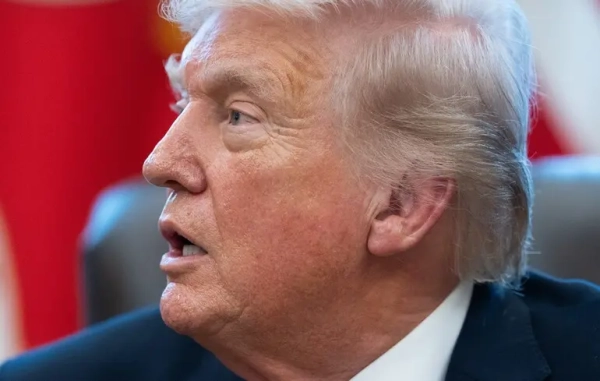
© EPA/AARON SCHWARTZ / POOL Americans are pessimistic about the state of the US economy.
Support for the economic strategies of U.S. President Donald Trump has diminished over the last month as prices surge due to the Iran war , with even Republicans displaying reduced faith in his decisions, according to a recent AP-NORC survey .
The survey reveals that endorsement of Trump’s economic strategies decreased to 30% in April, from 38% in March. A similarly modest 32% of U.S. adults endorse Trump’s actions concerning Iran, holding steady from the prior month.
The survey spanned April 16-20, a period during which Iran briefly “opened” the Strait of Hormuz before re-imposing a blockade — illustrating the volatile nature of the ongoing conflict.
Trump’s policies and pronouncements have exhibited inconsistencies. Fuel costs, which he pledged to diminish, have soared since the U.S. military intervention in Iran in February. His import taxes have largely paralyzed the American economy, and job creation has slowed.
A mere 33% of U.S. adults endorse Trump’s overall performance in his position — a decrease from 38% the previous month.
Trump receives notably low marks on the cost of living issue, per the recent survey, and approval for his job performance has declined in the past year, including among his own base. Only about a quarter of U.S. adults support his policies aimed at managing living expenses, indicating widespread disapproval of Trump’s approach to pricing.
The consumer price index increased by 3.3% in March compared to the previous year, slightly exceeding the 3% rate Trump inherited upon assuming office last year. However, Trump has demonstrated minimal focus on inflation and has minimized the significance of escalating energy costs resulting from the war with Iran.
Trump has minimized the repercussions of the war and has framed the approximate 35% surge in oil prices as a favorable outcome in comparison to what he anticipated. In a recent CNBC interview, he expressed surprise that oil prices remained around $90 per barrel, instead of the $200 he allegedly expected.
Widespread dissatisfaction with this perspective is evident even amongst Trump supporters. Barely half of Republicans support Trump’s handling of the cost of living challenge.
Younger Republicans express heightened dissatisfaction. Six out of ten Republicans under the age of 45 disapprove of Trump’s strategies for addressing the cost of living issue, compared to approximately four out of ten among the party’s older demographic.
Most Republicans who identify with the pro-Trump Make America Great Again (MAGA) movement largely continue to support the U.S. president. Ninety percent of MAGA Republicans endorse Trump’s performance, compared to 44% of non-MAGA Republicans, although only seven out of ten MAGA Republicans support Trump’s strategies for managing living costs.
In April, about three-quarters of American adults characterized the condition of the U.S. economy as “very” or “somewhat bad,” compared to approximately two-thirds in February.
Approval ratings for Trump’s economic strategies remain muted among independent voters and have diminished even amongst Republicans.
According to the new survey, twenty percent of independent voters endorse Trump’s economic policies, a slight decrease from thirty percent in March. A substantially larger proportion of Republicans, 62%, approve of Trump’s economic management, but that number has also declined from 74% the previous month.
Generally, Republicans exhibit less enthusiasm for Trump’s policies than they did in the period immediately following his inauguration. In March 2025, 51% of Republicans “strongly” endorsed his presidential performance, but that percentage has since declined to 38%.
Immigration, another critical concern for Trump, presents a comparatively favorable area for him, with 40% of Americans endorsing his relevant policies, remaining consistent with the prior month and exceeding his overall approval rating.
Trump’s current approval rating matches the lowest approval rating of his Democratic predecessor, Joe Biden, in AP-NORC surveys — 36%, recorded in July 2022 after an inflation spike. Biden’s approval rating has since improved as inflation receded, raising questions about Trump’s potential for a swift recovery.
Trump began his term last year with a relatively modest approval rating—42% in March 2025—a figure that has remained relatively consistent to date.
The AP-NORC survey, encompassing 2,596 U.S. adults, occurred from April 16-20. The margin of sampling error is plus or minus 2.6 percentage points.
A Reuters/Ipsos poll earlier this week suggested that a sizable portion of Americans are questioning Trump’s policies amidst a war with Iran and a dispute with the Pope. It also revealed that only 26% of Americans perceive Trump as “balanced.”
Trump’s declining approval ratings could pose challenges for his Republican Party, which intends to maintain its majorities in both the House and Senate during the upcoming midterm elections this fall.