
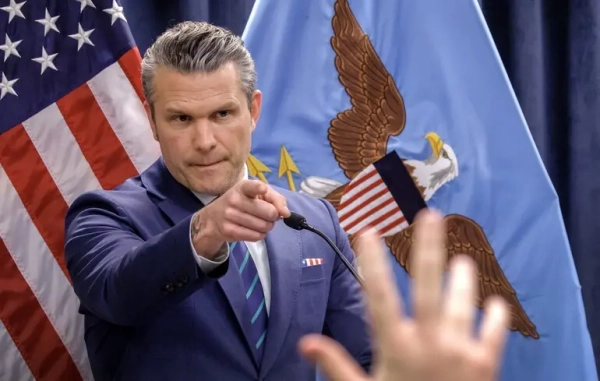
© EPA/ CRISTOBAL HERRERA-ULASHKEVICH The judge said the Ministry of War had ignored a previous court ruling.
A US federal judge has dismissed yet another endeavor by Secretary of War Pete Hegseth to curb media access to the Department of Defense , deeming it an effort to control how news outlets should report events, which resembles “autocracy, not democracy,” Politico indicates .
“Constraining First Amendment rights is perilous at any moment, and even increasingly so during a time of conflict,” remarked federal judge Paul Friedman on Thursday, April 9.
This marks the second instance Friedman has overruled Hegseth’s bid to restrict journalists’ access to the Pentagon. A prior media limitations strategy, that threatened to deprive journalists of their credentials should they not consent to publishing only War Department-approved information, was previously rejected by the judge.
Following Friedman’s pronouncement that the strategy was unconstitutional the prior month, Hegseth instituted revised regulations that once more imposed firm restraints on journalists’ capability to acquire data from Pentagon sources absent authorization from the department’s leadership.
Friedman, an appointee of former Democratic US President Bill Clinton , invalidated crucial segments of the amended policy, concluding that it merely represented a modification of past limitations.
“The Department cannot simply reinstate unlawful policies under the pretext of adopting ‘new’ measures and anticipate the court to disregard it,” Friedman articulated in a declaration.
A Pentagon representative conveyed that the administration of US President Donald Trump disagrees with the judge’s determination and intends to appeal.
“The Department has invariably adhered to judicial decrees. The Department is still dedicated to guaranteeing press admittance to the Pentagon while fulfilling its legal duties to function safely on Pentagon premises,” Pentagon spokesperson Sean Parnell posted on the X social network.
A protocol initiated by Hegseth the preceding year mandated that journalists endorse a pledge prior to procuring a press pass, stipulating that agency data must be “cleared for release by the relevant authorized official before dissemination, even if it is not classified.”
Subsequent to the regulations being disclosed last autumn, numerous journalists at prominent media organizations declined to endorse the policy, and press rights advocates condemned the regulations as an encroachment on press liberties. The Pentagon contended that the media was misunderstanding the regulations, which are legitimate.
Following a multitude of major media corporations refusing to endorse the policy, their reporters stationed at the Pentagon relinquished their press credentials last October. Consequent to this, for the first occasion since the Dwight Eisenhower administration (who served as president from 1953 to 1961), no principal American television network or publication maintained a sustained presence at the Pentagon.
This also provided the Pentagon with a “new press corps” comprising right-leaning, pro-Trump media entities and media figures. Journalists proceeded to report on the undertakings of the US military from locales external to the Pentagon. The New York Times brought a lawsuit against the policy last December.