
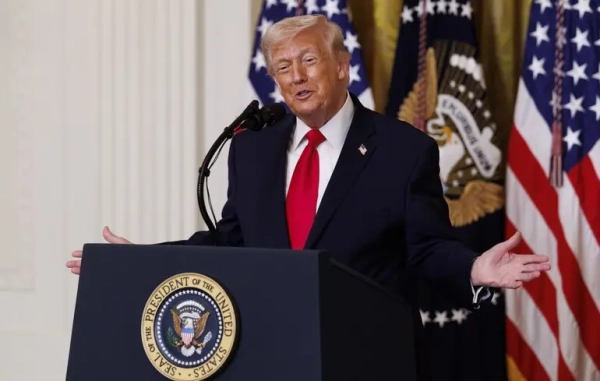
© EPA/ WILL OLIVER This wouldn’t be the first instance of Europe needing to confront the ramifications of Trump’s actions.
The actions of US President Donald Trump are creating upheaval. Europe is compelled to address the aftermath, or at the very least, shoulder a substantial burden to manage the repercussions. The EU is concerned this trend could recur in the Strait of Hormuz following Trump’s announcement of a cessation of hostilities with Iran , according to five European diplomats and officials speaking to Politico .
European leaders have already committed to assisting in safeguarding the seaway once the combat ceases. Now, not only might France, Germany, and Britain discover themselves needing to fund a costly undertaking to accompany ships and remove mines in the strait, but their commercial vessels could also be obliged to remit considerable tariffs, unparalleled prior to the conflict, simply to traverse the waterway.
On Wednesday, April 8, Trump indicated he was contemplating establishing a “joint initiative” with Iran and Oman to collect duties.
In the meantime, energy costs are anticipated to persist at elevated levels for weeks or potentially months if the armistice holds, and the pattern is becoming evident: Europe is increasingly obligated to disburse more just to maintain its association within a transatlantic partnership that has turned exceedingly unpredictable.
“This has evolved into a recurring theme. In Gaza, we are financing reconstruction. In Ukraine, we are funding the war – practically unilaterally at this juncture. And now, we might be compelled to cover the costs of clearing the Strait of Hormuz. NATO ought to be predicated on reciprocal commitment. However, that isn’t the operational reality,” states Nacho Sanchez Amor, a Spanish Socialist MEP and a member of the European Parliament’s Foreign Affairs Committee.
The forthcoming significant challenge
In the hours immediately following Trump’s declaration of a truce on Tuesday, April 7, abandoning threats to “completely obliterate” Iran, EU leaders celebrated a triumph for diplomacy. The eleventh-hour arrangement furnished a “much-needed” de-escalation, affirmed European Commission President Ursula von der Leyen.
Yet, even as European leaders experienced a sense of relief, they were preparing for the impending major hurdle: how to reinstate the strait’s operability. French President Emmanuel Macron conveyed on Wednesday that a consortium of 15 nations, encompassing France, would lend assistance in restoring transit via the strait “as soon as conditions permit.”
More easily articulated than executed. Even assuming the burden is distributed among the naval forces of various non-EU countries, inclusive of Australia and Britain, the expense of such an endeavor would be substantial. Operation Earnest Will, the US-led initiative that shielded Kuwaiti tankers from Iranian assaults in 1987–88, incurred several hundred million dollars for the participating nations, and when adjusted for inflation, likely surpassing a billion US dollars.
British Foreign Secretary Yvette Cooper also alluded to the imperative of reopening the strait in a statement on Wednesday. Nonetheless, her remarks underscored the necessity for a “swift resolution of the conflict” as opposed to naval accompaniment and mine removal.
Indeed, promptly after Trump proclaimed the ceasefire, British Prime Minister Keir Starmer and the EU's chief diplomat, Kaia Kallas, journeyed to the Middle East with the aim of solidifying the ceasefire’s permanence. The existing truce is presently slated to endure for a fortnight.
Starmer is scheduled to conduct “additional discussions regarding pragmatic strategies to reinstate freedom of navigation in the Strait of Hormuz” with a selection of Gulf leaders, while Kallas is anticipated to confer with the Saudi foreign minister and the head of the Gulf Cooperation Council.
“The paramount objective is that this truce is sustained,” expressed an EU diplomat privy to the dialogues.
Absent the necessity of a demining operation, Europe will in all likelihood continue to experience the consequences of the war on energy provisions and markets for an extended duration.
Upon being questioned concerning the rapidity with which gasoline prices would decline subsequent to the ceasefire, a French government representative stated: “I am exercising caution. We have previously encountered pronouncements pertaining to price ameliorations.”
Asserting dominance globally
That very circumspect disposition is anticipated to manifest itself at an informal assembly of European leaders later in the current month in Nicosia, Cyprus, wherein they will deliberate upon the ramifications of the Iran war and the funding of Ukraine.
According to the EU diplomat, the underlying reality is that Europe is persisting in suffering from the repercussions of its comparative vulnerability on the international platform.
“We lack the capacity, the ‘hard power’, to impose our directives upon the world. We find ourselves entrenched in attempts to negotiate and leverage our influence to extricate ourselves from predicaments and mitigate the ramifications,” the diplomat articulated.
The Expert Group of the Strategy XXI Center analyzed how a new war in the Middle East is reshaping the dynamics of the global economy, determining who will incur substantial losses and who will reap the benefits, in their article “ Trump opened Pandora’s box: how will we pay for the war in the Gulf ”.