
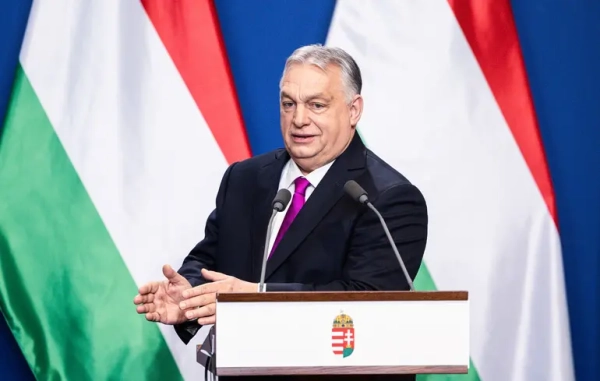
© Getty Images Throughout its 16-year tenure, Fidesz has enacted numerous changes and situated its allies in significant roles, which will impede the activities of any incoming administration.
The present Prime Minister of Hungary, Viktor Orban, has placed loyalists in crucial government positions, potentially hindering the budgets and laws of any incoming prime minister. Consequently, even if opposition leader Peter Magyar emerges victorious in Hungary’s forthcoming election this month, he will encounter a formidable challenge in effectively steering the nation through the intricate legal and political labyrinth established by Orban, Politico indicates.
During his 16 years at the helm, Orban has solidified firm dominance over vital state entities, signifying that his adherents will retain considerable authority to obstruct the Magyar party’s fiscal blueprints and repeal legislation via a politicized constitutional tribunal.
The difficulty for Magyar will be identifying a path to govern successfully without being compelled to initiate snap elections within a framework designed to undermine him.
Apart from Orbán’s sustained sway over budgets, numerous essential facets of public life, encompassing “fundamental laws” governing the judiciary, media, electoral process, public finances, family policies, and the church, can only undergo alteration if Magyar and his Tisza party manage to secure an unexpected two-thirds majority.
“The Orban government and the dominant Fidesz party are gambling that Tisza will falter due to inexperience and prove incapable of governing,” the report states.
“For Tisza to administer the country, they necessitate a cohesive vision for the nation’s progression, alongside a substantial political alliance supporting them. Their shared objective is solely to dislodge us from power. While this may or may not suffice to effectively displace us, it certainly falls short of what’s needed to govern the country,” remarked Hungarian Minister for EU Affairs János Bóka in comments to the publication.
Current opinion polls suggest that Magyar can only attain a simple majority. He will also need to grapple with the antagonism of Fidesz supporters holding key positions within the state apparatus, as their removal likewise demands a two-thirds vote in parliament.
“This will undoubtedly be an uphill battle, and I am quite confident that Orban will not ease the transition for his successor if he suffers defeat,” commented former liberal MEP and current opposition MP Katalin Cech.
Magyar's initial undertaking will be to formulate a budget capable of financing his ambitious campaign promises, which involve augmenting public expenditures on areas such as healthcare, following years of underfunding.
The issue is that Fidesz has significantly diminished public funds, reaching 50 percent of its 2026 deficit target by February, subsequent to introducing substantial pre-election subsidies aimed at securing voter approval.
Orbán could further complicate matters for the current opposition through one of his most potent strategies: the fiscal council. This entity comprises three Fidesz loyalists, recently appointed for terms extending from 6 to 12 years, possessing the power to veto the budget.
Hungarian President Tamás Sulók, also aligned with the Fidesz party, will remain in his post until 2029 and retains the option to call early elections if the government fails to approve a budget. The removal of both the fiscal council and the president from their positions necessitates a two-thirds parliamentary vote.
Magyar will encounter analogous hurdles in his efforts to unlock 18 billion euros in suspended EU funds, as he must implement reforms mandated by Brussels by an August deadline.
The requirement for a two-thirds majority for numerous crucial modifications stands as the principal impediment to the triumph of any new administration.
The implementation of “fundamental laws” spanning areas from the judiciary to the media constituted a pivotal aspect of Orbán’s 2011 constitutional overhaul, which was ratified in a mere nine days, ensuring that any forthcoming government would find it exceedingly challenging to alter numerous key policies.
The Venice Commission voiced apprehension at the time, deeming the two-thirds threshold for amendments excessive, particularly for “matters that should be relegated to the standard political procedure.” The Commission also expressed disapproval of the extensive authority vested in the Fiscal Council and its “repercussions on the proper operation of democracy.”
Fidesz has additionally appointed its adherents to other significant oversight roles, such as the state prosecutor, the ombudsman, and media representatives. These are all “genuinely significant, currently under control, and possess the capability to impede a non-Fidesz government,” stated Miklós Ligeti, legal director at Transparency International Hungary.
Fidesz has also integrated structural advantages into the aggregation of media ownership. In 2018, it established the Central European Press and Media Foundation (KESMA), wherein Orbán’s business associates facilitated the merging of hundreds of local, regional, and national media entities that now disseminate the Fidesz perspective. Any endeavor to modify this would necessitate – as anticipated – a two-thirds parliamentary majority.
The Constitutional Court stands as a prominent illustration of how Orbán can pose difficulties for Hungarians, given that the Fidesz party appointed all 15 of its judges, including the former defense minister, to the Fidesz party. The Curia, Hungary’s highest court, is presided over by András Varga, appointed by the Fidesz-controlled parliament. Any laws the Hungarian government attempts to enact could be deemed unconstitutional by the higher courts.
“In light of the prejudice of the Supreme Court, or at minimum its president, as well as the Constitutional Court, this will constitute a remarkably demanding struggle for “Tysa,” conveyed Adrienne Lazo, a former judge who resigned in November 2024 to protest the judiciary’s absence of independence.
Furthermore, in December, Orbán’s legislators reinforced the veto authority of President Sulyok, who secured a five-year term in 2024. Kim Lane Scheppele, a professor specializing in constitutional law and elections at Princeton University, asserts that Orbán has been strategizing for the most adverse scenario in the event of his defeat and has rendered impeachment of the president virtually unattainable.
Simultaneously, the president retains the prerogative to impede legislation by returning it to parliament or referring it to the Constitutional Court, which could declare it unconstitutional, thereby potentially nullifying any reform endeavors undertaken by Tysa.
Volodymyr Kim talked about what scenarios are possible after the elections in Hungary and how the topic of the “Ukrainian threat” became part of Orban’s political struggle in the article “ Viktor Orban’s Ukrainian Card: How Budapest Plays Kyiv .”