
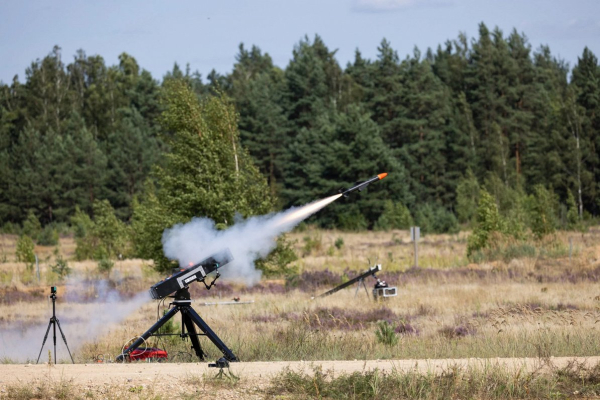
Poland is commencing a novel defense investment initiative, partnering with Estonian Frankenburg Technologies: the government-owned Polska Grupa Zbrojeniowa (PGZ) will domestically manufacture Mark I anti-UAV projectiles. This accord establishes a basis for a fresh industrial resource, capable of yielding as many as 10,000 rockets annually, thereby constituting a supplementary component within the nation's defense-industrial base.
The undertaking is geared towards fostering indigenous output of economical anti-drone countermeasures given the consistent surge in requirement for such platforms, spurred by the conflict in Ukraine and escalating worldwide security concerns. While the participants have not revealed the sum of capital allocated or completion timeframes, it revolves around establishing a modern manufacturing hub within Poland, which will bolster the domestication of know-how and curtail reliance on armaments purchased abroad.
PGZ is evaluating various locations for the plant, suggesting possible rivalry amongst areas for defense-related capital and linked infrastructure. The scheme anticipates amplifying production output, generating employment opportunities, and nurturing associated sectors, including microelectronics, substances, and motor engineering.
The arrangement furthermore stipulates further outlay in the advancement of the ensuing generation of Mark II projectiles, boasting an extended reach of up to 5–8 km, unveiling opportunities for extending the undertaking’s scope and intensifying technological partnership between Poland and Estonia.
In general, the endeavor mirrors a tendency toward industrial expansion within Europe’s defense domain, where the focus is being re-directed to large-scale manufacture of relatively budget-friendly and potent methods for countering unmanned aerial vehicles. For financiers, this is an indication of the emergence of an innovative, rapidly expanding marketplace, wherein the tempo of production deployment, item expense, and the degree of technology regionalization are evolving into critical determinants.
Source: liga.net