
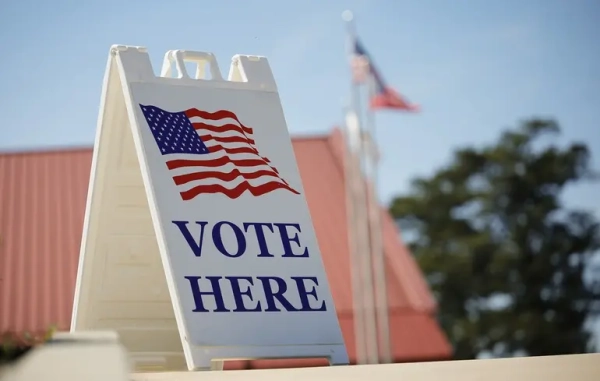
© EPA/ ALEX SLITZ Following the Democrats' setbacks in 2024, several prominent contributors are hesitant to invest further in the party.
Democrats are approaching the congressional elections with an advantage in organization, polls and interest among their supporters. However, they lag behind their Republican counterparts in one crucial area: funding, Bloomberg reports .
Following the Democrats’ significant losses in 2024, a number of the party’s major benefactors are reluctant to contribute again, many feeling let down after heavily backing Democratic contender Kamala Harris’s unsuccessful presidential campaign. While certain individual Democratic hopefuls have successfully gathered funds in local races, the party and numerous external organizations have experienced varying degrees of success in this regard.
“Seeing $2 billion vanish in 107 days is discouraging. You invest in those you trust with your resources,” stated attorney John Morgan, a veteran Democratic fundraiser, alluding to Harris’s electoral run two years prior.
Despite voter discontent over living costs that have diminished backing for Republican President Donald Trump, Republican Party fundraising remains robust. The party, its affiliated fundraising groups in both chambers, and pro-Trump entities have amassed $750 million thus far, according to their latest submissions to the Federal Election Commission.
This is roughly quadruple the $193 million jointly held by the Democratic National Committee, the Senate and House groups, and the party's super PACs.
A further point of contention for Democratic donors was the Democratic National Committee’s obligation to settle debts connected to Harris’ presidential bid, in spite of the unparalleled volume of resources acquired for her at the eleventh hour, when then-President Joe Biden withdrew his candidacy.
The Democratic National Committee’s total indebtedness at February’s close amounted to $17.4 million, surpassing the $15.9 million it possessed in its coffers. This came after the party cleared over $18 million in unpaid bills from its 2024 presidential endeavor, encompassing charges agreed upon by the Harris campaign. The Democratic National Committee also bore a $15 million loan from Amalgamated Bank. Repayment of this debt is yet to commence.
These financial challenges represent a blemish on a series of Democratic achievements in recent times, including those in local contests. With the November midterm votes drawing near, Democrats are increasingly optimistic they can reclaim the House of Representatives and at least narrow the Republican advantage in the Senate. However, a funding shortfall could undermine these ambitions.
Democratic National Committee Chairman Ken Martin, however, is of the opinion that the Republican Party's monetary lead will not pose an issue for Democrats.
“We don’t have to accumulate more funds than the Republicans. We simply require enough to participate and compete, which is precisely what we are doing,” Martin conveyed to Bloomberg.
A Democratic National Committee official, speaking anonymously, revealed that last year’s fundraising efforts were noticeably superior to those in 2017, when Democrats were last shocked by a Trump victory. The committee also asserts it has invested significantly in party infrastructure — including state and campaign funding and fresh voter registration and mobilization initiatives — and suggests these investments are contributing to successes.
Not all presidential campaign contributors are “opening their wallets” during the midterm races. And for those inclined to do so, ample opportunity remains, with the midterm election day still over seven months away.
Simultaneously, certain individual Democrats have demonstrated that “the reservoirs are not entirely dry.” Virginia Governor Abigail Spanberger secured over $70 million for her victorious 2025 gubernatorial contest. Moreover, Pennsylvania Governor Josh Shapiro collected more than $23 million in 2025 for his reelection bid this year.
Alan Kessler, a Democratic Party fundraiser, indicated that his financial campaign for Shapiro has met with substantial success.
“People are displaying genuine generosity. I don’t hear anyone declaring, ‘Following 2024, I’ll no longer participate,’” he remarked.
Nonetheless, it’s apparent that some of the Democratic Party’s most substantial backers have not exhibited initiative in 2026. On the whole, Democrats currently possess fewer affluent donors compared to the Republican Party.
Certain Wall Street contributors who typically back Democrats have conveyed discontent with the Democratic National Committee (DNC) and Martin's directorship. The DNC chairman has faced critique for concealing a report dissecting the 2024 election outcomes, asserting it was paramount to concentrate on future contests. Many also hold the opinion that the committee has neglected to explicitly articulate a vision for the party. Furthermore, there are prosperous Democratic supporters who harbor fears that the party has veered too far left.
The midterm elections for the US Congress are slated for November 3 of the current year. The Hill reported that Republicans are apprehensive that unfavorable public sentiment towards certain of Trump's policies could precipitate a surge of Democratic triumphs that would jeopardize the Republican majority in Congress. Axios indicated that Republicans are fearful of forfeiting both the House of Representatives and the Senate.
Many still maintain that the next US election can “correct” American governance. However, the predicament extends deeper: an increasing number of Americans harbor distrust for both Republicans and Democrats alike. This crisis is affecting more than simply Washington. Petro Gerasimenko discussed about how “ America is tired of Democrats and Republicans. What can we expect from Ukraine and Europe now ?”