
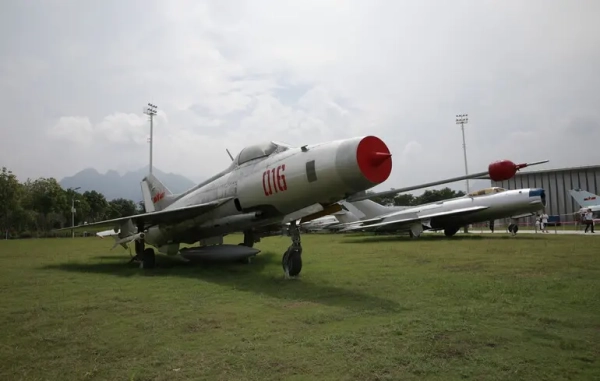
Illustrative photo © Getty Images Though not the most hazardous or sophisticated drones possessed by China, confronting these UAVs would be expensive, experts suggest.
China has stationed aged, high-speed fighter planes repurposed as strike drones at six aerial bases in proximity to the Taiwan Strait , as reported by Reuters .
Based on a recent analysis from the Mitchell Institute for Aerospace Studies and satellite-derived images, these landing strips are likely to house swept-wing aircraft akin to the J-6 fighter aircraft, initially utilized by the Chinese Air Force in the 1960s. Subsequent to being transformed into drones, these planes were identified at five installations in Fujian province and a single one in Guangdong province.
Michael Dam, a senior fellow at the Mitchell Institute, indicated that the Chinese People’s Liberation Army has positioned about 200 or more outdated fighter planes, altered into drones, at aerial installations bordering the Taiwan Strait.
These planes, redesigned into UAVs, might strike objectives in the opening phases of a Taiwan invasion, according to Dam. They could function as cruise missiles instead of independent or remotely operated drones.
“They could launch an overwhelming attack on targets in Taiwan, the U.S., or among allies, essentially overpowering air defense systems,” the researcher stated further.
China commands the international commercial drone sector, and the nation is investing extensively in military UAV technology, augmenting the firepower essential to seize control of Taiwan by force if required. The converted aircraft highlighted in the Mitchell Institute’s analysis constitute a component of Beijing’s burgeoning air force inventory, which encompasses long-distance missile-capable bombers, cutting-edge fighter planes, ballistic projectiles, cruise missiles, and numerous advanced UAVs.
“The primary intention behind these drones is to deplete Taiwan’s air defense capabilities during the preliminary strike wave. To hinder China from hitting vital targets, we will inevitably need to address the fiscal prudence of deploying costly missiles to intercept them from afar,” stated a high-ranking Taiwanese security official.
In a report submitted to parliament this week, Taiwan’s Defense Ministry detailed strategies to swiftly procure advanced anti-drone technologies.
Should China invade Taiwan, it might initiate a “massive assault” utilizing strike aircraft, missiles with varied flight patterns, as well as both fast and slow drones, according to Peter Layton from Griffith University in Australia, a retired captain from the Australian Air Force with prior service at the Pentagon.
“A range of distinct threats simultaneously… It would present an air defense challenge of enormous proportions,” he commented.
These UAVs are not China’s most potent or cutting-edge drones, yet confronting them will be resource-intensive. The compact, rapid interceptor drones utilized by Ukraine to counter Russian offensives would lack effectiveness in shooting down such UAVs, Leighton opines.
“These J-6s will necessitate a correspondingly expensive missile,” he points out.
The conflict between Russia and Ukraine, alongside the US-Israeli operation against Iran, have underscored that drones now represent a pivotal element of modern warfare. Specific models can be manufactured in large quantities, fielded in mass formations, and readily replaced following battlefield losses.
The J-6 was modeled after the Soviet MiG-19 fighter plane of the 1950s. This version, along with other Soviet-inspired aircraft, served as the foundation of China’s fighter fleet until the mid-1990s, as per the U.S. Air Force University. Dam approximates that over 500 of these planes have been transformed into drones. The UAV variant of the J-6 carries the designation J-6W.
Last September, the Chinese air force showcased one of these converted fighters at an air show in northeastern China. An informational placard positioned near the drone identified it as a J-6 unmanned aerial vehicle — an adjusted version of the J-6 fighter aircraft. The fighter aircraft had its weaponry and associated gear removed and was outfitted with an automated flight control mechanism and navigation technology utilizing terrain awareness.
Chinese airfields situated closest to the Taiwan Strait, the operational bases of the J-6 UAVs, would be susceptible to counterattacks from Taiwan and its allies in the event of a confrontation, Dam observes.
“The strategy involves deploying all the drones in the opening hours of the operation,” he stated further.
Beijing regards Taiwan as its own territory and has consistently maintained the option of employing military force to assert dominance over the island. Taiwan refutes Beijing’s assertions. According to a new evaluation from the U.S. intelligence community, China is not presently outlining a strategy to invade Taiwan in 2027. This contrasts with the Pentagon’s annual report on China’s military prowess late last year, which conveyed that Beijing “anticipates being equipped to initiate and prevail in a war against Taiwan by the close of 2027.”