
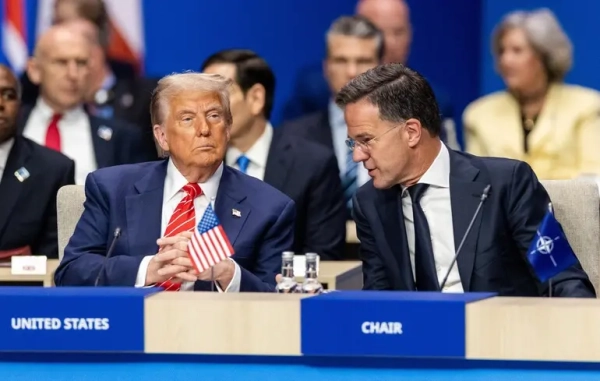
© EPA-EFE/SEM VAN DER WAL The idea from Rutte to position its naval forces in the Hormuz Strait has sparked indignation across European capitals.
NATO Chief Mark Rutte has infuriated European leaders with his strong endorsement of US President Donald Trump’s combat against Iran , amid the continent’s struggle with the energy crisis resulting from the dispute, as reported by the FT.
Rutte’s assertion that European allies would eventually “unite” to comply with Trump’s appeal to station maritime units in the Strait of Hormuz has provoked the ire of officials in numerous European capitals, according to FT’s sources, heightening divisions within NATO regarding the degree of compromise acceptable for a pivotal member of the alliance.
“This places us in a truly uncomfortable and challenging spot. We aim to demonstrate readiness, yet it is also true that we lack the capacity to engage in any form [in the conflict],” an EU diplomat commented.
The doubt prevalent across numerous European capitals concerning the war, which has unleashed devastation in the Middle East and caused a spike in oil and gas prices, starkly contrasts with the remarks of Rutte, who frequently attempts to commend Trump while striving to maintain the US involvement within the alliance.
“He is undertaking this to ensure global security,” Rutte stated recently regarding Trump’s resolution to attack Iran.
“It is only rational that it will necessitate several weeks for European nations to achieve an agreement,” he further added, alluding to the American leader’s request for NATO allies to participate in a mission to protect vessels traversing the Strait of Hormuz, which is currently under Iranian blockade.
Trump has rebuked NATO allies for their failure to heed his entreaty, branding them as “cowards” and cautioning that in the absence of the United States, the alliance is merely a “paper tiger.” Ever since his return to the White House last year, Trump has persistently challenged transatlantic solidarity on matters such as trade, defense expenditure, and proposed acquisitions of Greenland.
Last week, EU nations, all but three being NATO members as well, turned down Trump’s proposal for a mission in the Strait of Hormuz.
Three European diplomats voiced their anxieties regarding the variance between Rutte’s declarations and the stance adopted by the majority of European allies. Despite seeing no justification for directly criticizing Trump, they also disagreed with his backing of the US president’s choice to initiate war.
“This war is also… a politically disastrous error for all parties involved. And that is what causes me the greatest dismay: a war that was preventable, a needless war,” declared German President Frank-Walter Steinmeier on Tuesday, March 24.
The Head of the French Armed Forces, Fabien Mandon, communicated that the US is demonstrating increasing unpredictability and does not deem it essential to notify allies prior to initiating military actions.
“This impacts our security. This impacts our interests,” he supplemented.
“NATO is not engaged in combat with Iran, but it is intently monitoring the circumstances to uphold the safety of its allies. The Secretary General maintains ongoing contact with the Alliance leaders,” a NATO spokesperson conveyed to the FT.
Certain European capitals, spearheaded by Paris, have communicated their willingness to potentially take part in policing the strait post-conflict to safeguard the crucial waterway.
Simultaneously, some European officials have privately articulated their reservations about fully distancing themselves from the war, given its consequences on oil and gas prices, which result in escalating costs for households and businesses across Europe.
“The effects concern us; therefore, this is our dispute,” one official emphasized, adding that numerous national capitals are in contact with the Middle Eastern states impacted by the war, with the intention of securing a diplomatic resolution.
Politico previously indicated that Rutte’s time-tested methodology for navigating Trump has faced strain as the Iran war unveils fresh fractures within the alliance. The absence of unanimity and NATO’s constricted function in the Middle East render the emergent crisis remarkably challenging to address.