
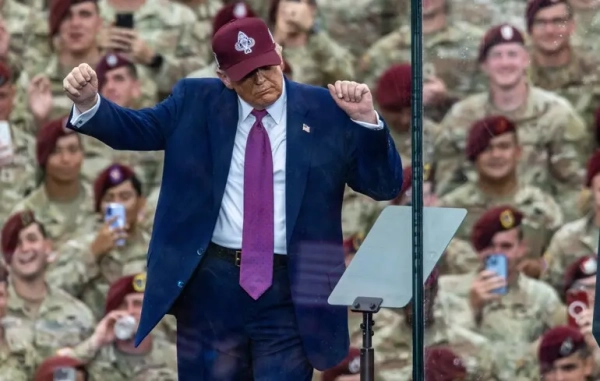
© EPA/STAN GILLILAND Elite US soldiers are preparing for actions aimed at Iran.
The Pentagon is considering sending several thousand soldiers from the distinguished 82nd Airborne Division to the Middle East amidst growing tensions with Iran, reported The Wall Street Journal, citing sources within the defense establishment.
This is a combat brigade consisting of roughly 3,000 troops, forming a part of the US Army's quick reaction force. It possesses the ability to be stationed in any location around the globe in under 24 hours and specializes in military landings in hazardous zones.
According to information obtained, the US might deploy a total of three to four thousand troops. Their base is located at Fort Bragg in North Carolina.
This action is part of a wider expansion of the US military’s presence in the region, which has already dispatched several thousand Marines and naval vessels, including the amphibious assault ship USS Boxer.
Before the increase in forces, there were approximately 50,000 American soldiers stationed in the region.
As of now, there is no official decree to position US soldiers directly within Iranian territory. Nevertheless, the movement of paratroopers considerably broadens the possibilities for such situations.
Among the choices being deliberated by the administration of US President Donald Trump:
- the forceful clearance of the Strait of Hormuz for maritime traffic;
- capturing key islands or Iran’s coastline;
- the operation targeting Kharg Island, a vital hub for Iranian petroleum exports;
- taking control of highly enriched uranium stockpiles.
Analysts emphasize that even a limited deployment of ground troops could substantially elevate the hazards and scope of the conflict.
A prospective land-based operation could present a significant political obstacle for Donald Trump, who has previously pledged to refrain from involving the US in new conflicts in the Middle East.
According to surveys, the majority of US citizens do not endorse a military campaign against Iran. Approval ratings for strikes have decreased to 35%, while over 60% are against them.