
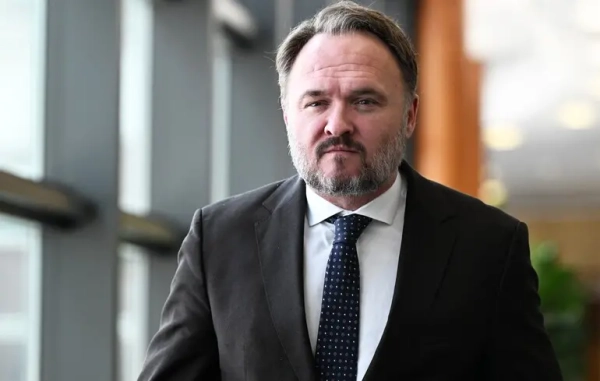
© EPA/ JOHN THYS / POOL The EU Commissioner underscored that the EU must not replicate its past errors.
The European Union will maintain its resolution not to acquire Russian oil, even considering the current crisis in the Middle East, stated European Commissioner for Energy Dan Jorgensen. He made these comments to journalists in response to the Belgian Prime Minister's suggestions to re-evaluate relations with Russia, especially concerning the energy sector, according to Radio Liberty .
“Within the European Union, we’ve decided against importing Russian energy… It's crucially important that we remain steadfast. We cannot, within Europe, directly aid in funding Russia’s brutal and unlawful conflict. We have been overly reliant on Russian energy for an extended period, enabling Putin to exert pressure on us,” Jorgensen emphasized.
He stated the EU was committed to preserving its path towards independence from Russian energy resources. He affirmed that it would constitute a mistake to “redo what we have done previously.”
“Therefore, the message is quite definitive: in the times ahead, we will not secure a single molecule from Russia,” the European Commissioner included.
Regarding the effects of the war in Iran on the EU energy market, Jorgensen conveyed that there are no issues concerning supply assurance. He mentioned the EU imports a minimal amount of energy supplies from the Middle Eastern countries affected by conflict. However, Europe is experiencing the overall consequences of the energy deficit, such as price increases.
“We are deeply aware of the need to not only oversee the situation, which we are, of course, actively doing, but also to prepare, as the situation could intensify further. We also need to be ready to implement immediate measures to support member states in such circumstances,” Jorgensen articulated.
According to him, increasing the proportion of renewable energy sources in Europe, coupled with enhanced interconnection of energy infrastructures, will assist in lowering costs.
As a reminder, Belgian Prime Minister Bart De Wever stated that Europe should avoid repeating prior missteps in its relationship with Russia, highlighting the importance of rearmament and troop deployment on its eastern boundaries. Concurrently, in his view, the EU should “normalize relations with Russia and reinstate access to economical energy.” De Wever characterized this as practical. The Belgian Prime Minister additionally urged the European Union to obtain a mandate from member states for discussions with Russia, given its prior inability to compel Moscow to cease its conflict against Ukraine.
In response, Belgian Foreign Minister Maxime Prevost cautioned that reinstating routine relations with Russia would be interpreted as a display of weakness . He endorsed the notion of the EU engaging in negotiations to put an end to the war in Ukraine. Nevertheless, he stressed that European nations must persist in applying financial strain on the Kremlin to clear the way for truly fruitful negotiations. Simultaneously, de Wever maintains that lacking the involvement of the United States, sanctions imposed on Russia remain ineffective.