
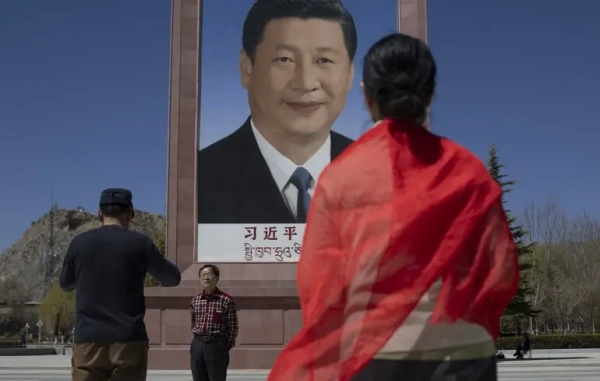
© EPA/ ANDRES MARTINEZ CASARES The new legislation aims to transform Xi's idea of “building a strong sense of unity of the Chinese nation” into “the will of the state.”
China has enacted legislation that cements President Xi Jinping’s strategy of incorporating its ethnic minorities—a divergence from Beijing’s time-honored approach of affording such groups at least token self-governance, Bloomberg indicates .
Over 2,760 representatives in the National People’s Congress cast their votes to approve the Law on Promoting Ethnic Unity and Progress on Thursday, March 12. A trio of representatives dissented, and another trio abstained from voting.
The full text of the legislation has not been made available by the Chinese government; however, the draft indicates it solidifies the elevated position of Mandarin Chinese within education and cautions against external meddling in ethnic matters. The significance of this law to the upper echelons of leadership is underscored by the fact that a deliberation on the draft occurred during a meeting of the Communist Party’s Politburo in August.
The law will be instrumental in “averting and resolving critical hazards and latent risks,” as declared last week by Zhao Leji, who presides over the Standing Committee of the National People’s Congress and holds the third-highest rank in China’s hierarchy. He further stated that ethnic concerns are intrinsically linked to the cohesion of the nation, border security, and societal equilibrium.
Detractors express concern that the law intensifies the strain on ethnic minorities in a country predominated by the Han Chinese populace.
“Beyond its impacts on marginalized ethnic minority communities across China, this law is poised to further curtail both educational and religious liberties in Tibet and Xinjiang Province in the northwest, while bestowing a semblance of legitimacy on Beijing’s continuing breaches of human rights,” noted the Foundation for Defense of Democracies in their statement.
Chinese state-affiliated media asserts the legislation will yield favorable outcomes for minority rights; the China Daily newspaper posted Thursday that the novel law will “bolster the advancement and safeguarding of ethnic languages.”
However, the version under final review dictates that Mandarin Chinese must serve as the language of instruction within schools and academic institutions, in accordance with the newly revised Standard Chinese Language Law. In 2020, the Chinese administration initiated steps to discontinue bilingual instruction and employ only Chinese in pockets of Inner Mongolia, triggering protests among activists claiming this initiative would decimate their Mongolian heritage. Comparable regulations have been enacted previously in Xinjiang and Tibet.
Furthermore, the fresh law stipulates that any external entity or individual jeopardizing China’s ethnic solidarity and instigating discord will be held liable, though specifics remain vague.
The legislation endeavors to metamorphose Xi’s vision of “forging a robust sense of unity among the Chinese nation” into “the state’s mandate,” according to Zhao’s address to lawmakers last week. He also indicated that the law elevates “successful endeavors” in tackling ethnic dilemmas to the status of legal statutes.
According to Allen Carlson of Cornell University, the law unequivocally states that ethnic minorities in China “must amplify their efforts to assimilate with the Han majority and, above all, demonstrate allegiance to Beijing.”
Since assuming office in 2012, Xi has reinforced oversight of ethnic minorities across China, notably within Xinjiang, Tibet, and Inner Mongolia. Millions of Uyghurs residing in Xinjiang have been exposed to heightened governmental monitoring and compulsory labor initiatives, which Western critics have characterized as forced servitude . Conversely, the Chinese government refutes any maltreatment of human rights, having once denounced the allegations as “the lie of the century.”
Xi has placed considerable importance on the unification of “unsettled” border regions such as Tibet and Xinjiang. He personally spearheaded delegations for the anniversary festivities commemorating the formation of both Xinjiang and the Tibet Autonomous Region in the past year, departing from decades of precedent wherein such engagements were overseen by officials of lesser rank. Additionally, he has made extensive investments. Construction commenced last year on a hydroelectric dam valued at $167 billion in Tibet, a venture poised to define Xi’s “legacy” as he seeks to employ economic measures in reshaping the region and extending his reach in South Asia.
Xi’s far-reaching campaign against corruption has also resulted in the dismissal of leading figures from various ethnic autonomous regions, including Tibet, Inner Mongolia, and Guangxi. All three were members of ethnic minority groups, and their ousters seemingly imply that the Chinese leader has deprived ethnic minorities of the “privilege” they had previously been granted over recent decades.