
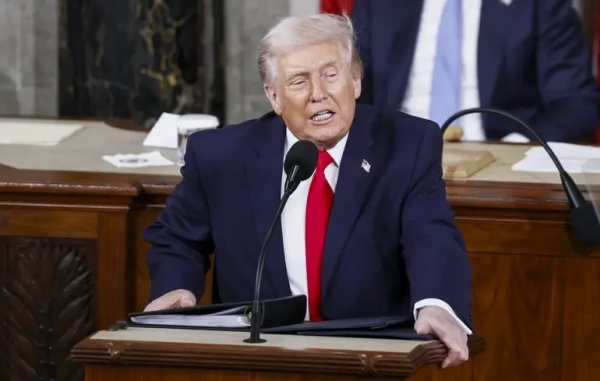
© EPA/ WILL OLIVER The document portrays a firmer cyber posture but lacks extensive specifics.
The US President Donald Trump's government has launched a fresh cyber strategy that situates digital protection within the broader framework of global political considerations, vowing to motivate the private sector to detect and counteract cyber threats, the WSJ indicated .
In contrast to the National Cybersecurity Strategy for 2023 from Trump’s predecessor, Joe Biden, which spanned more than 35 pages and detailed a multitude of policy proposals, the updated document is notably shorter (five pages) and articulates overarching tenets for forthcoming policy choices and priorities.
Sean Cairncross, who organizes US cyber policy and the efforts of various bodies in the cybersecurity domain, characterized the document at a sector gathering last year as “a concise declaration of intent and policy.”
What does the strategy cover?
The document encompasses policy declarations on a spectrum of extensive subjects: discouraging U.S. rivals, regulatory changes, crucial infrastructure security, modernizing federal networks, and the hazards of emerging technologies such as artificial intelligence and quantum computing. It also addresses personnel matters, emphasizing the requirement to educate cyber specialists. The strategy does not delineate how novel cybersecurity endeavors will receive funding.
The White House communicated that the government would utilize the “complete spectrum” of U.S. protective and aggressive cyber capabilities and employ “all instruments of national influence” to dissuade hostile hackers. On Friday, March 6, Trump signed an executive decree mandating that diverse agencies formulate strategies across diplomacy, law enforcement, and national security to tackle cyber-driven fraud and scams.
The strategy was anticipated to incorporate specifics on how the government would involve private sector proficiencies in more “offensive activities,” but it merely asserts that it will “establish incentives” for private enterprises to pinpoint and disrupt inimical networks, along with augmenting government abilities.
Fears about new technologies
The strategy frames the advancement of innovative technologies, like artificial intelligence and quantum computing, as a pivotal aspect of rivalry between dominant nations. It advocates for safeguarding US supremacy in these spheres while guaranteeing the protection of the infrastructure that supports them, including data hubs, supply chains, and the wider AI technological landscape.
Concurrently, the Trump administration affirms that the US government will broaden the application of AI to safeguard federal networks.
How does the new strategy differ from the previous administration's approach?
The Biden administration's 2023 cyber strategy laid out comprehensive policy initiatives geared towards reinforcing the regulatory system, securing software supply routes, and transferring greater accountability for cybersecurity to major technology providers.
Conversely, the Trump administration’s strategy places greater emphasis on overarching priorities. It promotes “pragmatic regulation” that lessens the compliance pressure on corporations and empowers the industry to react more swiftly to cyber threats, consistent with the government’s broader deregulation program.
Trump’s strategy also underscores the imperative to elevate the tally of cybersecurity personnel and pledges to “eliminate obstacles” between academia, government, and the military, which will contribute to increasing the number of workers. The document alludes to employing “available capabilities” in academia and the private sector to realize this objective but refrains from detailing the precise subject matter under consideration.
Recent accounts indicate that US investigators harbor suspicions regarding Chinese hackers’ cyber-meddling within the Federal Bureau of Investigation's internal computer infrastructure, encompassing information pertaining to certain internal surveillance directives. The scope and intensity of the cyber intrusion remain unknown, with the investigation in its preliminary stages.
The FBI is equally pursuing the investigation into the cyberattack perpetrated by the Chinese group Salt Typhoon , which current and former U.S. intelligence officers have depicted as one of the most significant U.S. intelligence blunders in history. The assault furnished Chinese spies with entrance to substantial quantities of customer call records in the United States, unencrypted confidential calls and text correspondence from at least a dozen prominent officials, including President Donald Trump, alongside delicate law enforcement particulars and technical network specifics potentially exploitable in future incursions.