
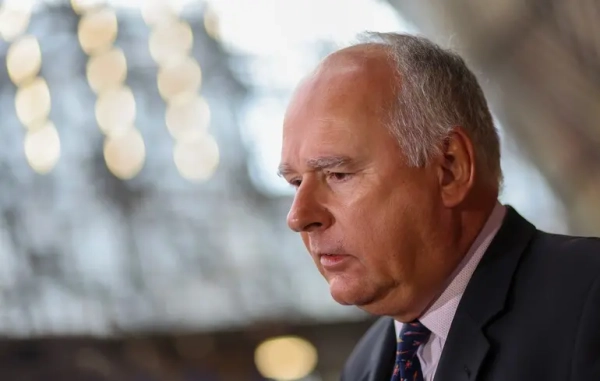
Polish Deputy Defense Minister Pawel Zalewski © EPA/OLIVIER HOSLET Minefields will be situated along the frontier in case of a genuine menace of Russian incursion.
Poland has formally pulled out of the Ottawa Agreement concerning the Banning of the Manufacture, Stockpiling, and Use of Anti-Personnel Mines. As per Deputy Defense Minister Pawel Zalewski, these kinds of mines will serve to safeguard its eastern boundary from Russia, the Associated Press reports.
“Such mines are a vital component of the defense infrastructure that we are establishing on NATO's eastern edge, within Poland, bordering Russia to the north and Belarus to the east,” the official stated.
Poland endorsed the Ottawa Agreement in 2012 and finalized the elimination of its reserves of anti-personnel mines in 2016. Currently, the nation has formally exited the agreement and intends to recommence the creation of these armaments. According to Zalewski, Russia displays “highly hostile intentions toward its neighboring countries” and has never signed up to the global agreement prohibiting anti-personnel mines.
The official further mentioned that Poland will commence producing both anti-personnel and anti-tank mines, underscoring that the government will work together with Polish producers. He indicated that Poland will only deploy mines along its frontiers “should a real danger of Russian aggression materialize.”
“We are not an aggressive nation, but we must employ all resources to restrain Russia,” he emphasized.
Previously, Polish Prime Minister Donald Tusk mentioned that Warsaw could position anti-personnel mines along its eastern boundary within a 48-hour timeframe if a threat arises. Poland is planning to implement the mines as a constituent of the Eastern Shield initiative to reinforce its boundaries with Belarus and Kaliningrad.
It is worth noting that last year, other neighboring countries of Russia also declared their departure from the Ottawa Agreement: Latvia, Lithuania, Estonia, and Finland. Ukraine also exited the convention.