
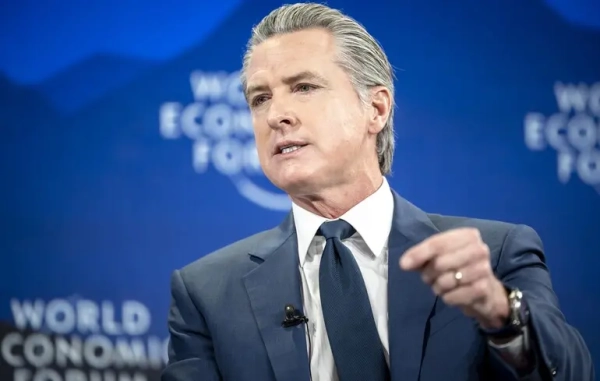
Gavin Newsom © EPA/ GIAN EHRENZELLER European leaders are split regarding how to engage with Trump.
Emissaries from the US Democratic Party intend to utilize the Munich Security Summit to implore European heads of state to confront US President Donald Trump, according to a report by The Guardian .
Among the Democratic participants at the yearly Munich assembly will be some of Trump’s most forthright detractors, including California Governor Gavin Newsom, Representative Alexandria Ocasio-Cortez, Senator Ruben Gallego, and Michigan Governor Gretchen Whitmer.
Newsom has previously exhorted Europeans to comprehend that “ingratiating themselves to Trump” renders them “pitiful on the global stage,” remarking to journalists at the World Economic Forum in Davos last month that “he should have provided a few pairs of kneepads.”
Gallego’s remarks were nearly as blunt.
“[Trump] is eroding our global standing and conceivably our economic influence worldwide because he is narrow-minded. Nothing about this is logical. Everyone must cease pretending it is logical,” the senator asserted.
However, the American contingent will be headed by US Secretary of State Marco Rubio. While European leaders anticipate he will convey a gentler message than US Vice President J.D. Vance's address last year, they also disagree on the optimal approach to Trump.
Certain individuals, steered by French President Emmanuel Macron, have stated that a fresh, more assertive form of diplomacy is essential to counteract what the Munich conference’s organizers termed Trump’s “politics of destruction.” Others, such as NATO Secretary General Mark Rutte, maintain that maintaining Trump’s “favor” is indispensable for European security.
Vance’s discourse ignited a debate in European capitals concerning whether the United States and Europe possess identical values, and if not, how rapidly the parties can dissolve ties.
Since that time, Trump has routinely disparaged the EU, engaged in “resource imperialism” internationally, and discovered justifications to vindicate Russian dictator Vladimir Putin. Rubio’s European sojourn will incorporate visits to Hungary and Slovakia, two EU nations most averse to assisting Ukraine.
Ordinarily, the American delegation in Munich has strived to avoid publicizing its domestic political disagreements, but this year those disparities appear insurmountable, and Democrats are poised to align with Europe in resisting what they perceive as Trump’s domineering diplomacy.
Democrats may be tempted to counsel Europe to exercise patience and await a return to normalcy. Trump’s declining approval numbers have already spurred Republicans in Congress to oppose the president on tariffs, and Democrats are hopeful that this dissension within the Republican factions could escalate as the midterm elections draw near, which could evolve into a considerable rout for the GOP.
Nevertheless, numerous individuals in the West now believe that the established rules-based system has vanished irrevocably, yielding to a novel, treaty-centric one, wherein major powers formulate and revoke agreements, proclaiming that might equates to right. That constituted the core message communicated by Canadian Prime Minister Mark Carney in his Davos presentation, declaring a “collapse” in the global arrangement.
Consequently, a substantial portion of the three-day conference in Munich, slated to showcase addresses by German Chancellor Friedrich Merz, British Prime Minister Keir Starmer, French President Emmanuel Macron, and European Commission President Ursula von der Leyen, will be committed to all of these matters.
Positioned on one side stands Macron, who conveyed this week that tensions between Europe and the US could intensify following the recent “Greenland episode,” wherein Trump menaced imposing tariffs on European countries that opposed his endeavor to seize control of the Arctic island from Denmark.
Conversely, on the other side is Rutte, who lately remarked: “If anyone present believes that the European Union or Europe broadly can defend itself absent the US, then persist in dreaming. It remains unattainable.”
One Baltic diplomat expressed that the current seemed to be tilting in favor of the NATO secretary general’s accommodating strategy. The diplomat articulated that the lesson gleaned from the recent quarrel with Trump over Greenland indicated that when Europe threatens to employ its economic might, the US president relents. However, he conceded that he awakens each morning contemplating how to render his nation more indispensable to the US.
The journey toward a more autonomous European defense represents a challenging one. Defense expenditure is on the rise, but the continent comprehends that efficacious rearmament necessitates time. Concerning Ukraine, Starmer insists that the requisite security assurances following any peace accord with Russia still mandate commitments from Washington to possess credibility.
Yet, in other respects, the detachment from America has already commenced. In recent months, Carney, Starmer, and Macron have striven to reignite relations with China, extending dialogue devoid of animosity. Beijing has demonstrated its capacity to reshape global supply chains and could emerge as a beneficiary of Trump’s undermining of multilateralism.
In a further indication of Europe’s inclination to pursue a separate route, Italy and Poland, the two nations currently closest to the US, have united with other European allies in declining to participate in Trump’s “Peace Council” — a convoluted “construct” conceived to position the present American leader’s ego at the nucleus of peacemaking, rejecting the UN.
However, as has been the circumstance for the preceding four years, Europe's destiny remains intertwined with the fate of Ukraine. Trump's appeals for a peace arrangement on Putin's terms, and J.D. Vance's declaration that this does not constitute America's conflict, collectively present Europe with a demanding selection regarding its priorities.
Europe is still endeavoring to communicate via the medium of “dialogue,” however, the established guidelines of the engagement have long since shifted: conventional security structures are fracturing, transatlantic consensus is dissipating, and the aggressor is capitalizing on lulls. Within such a framework, half-measures merely amplify the peril. Why prudence has grown more perilous than assuming risks, and preventive measures represent the singular avenue of escape, Mykhailo Gonchar penned in the article “ Chopping off the paws of the predator: what Europe’s new security requires .”