
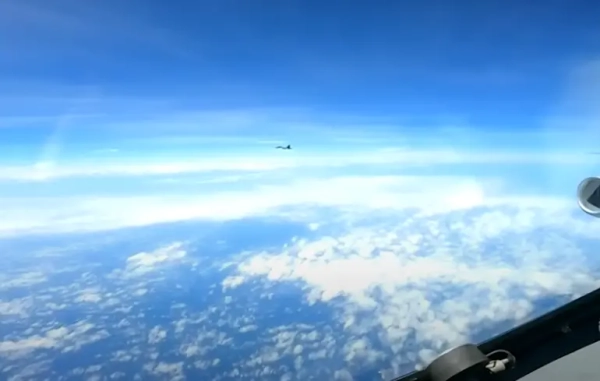
Illustrative photo © Youtube video screenshot The recent occurrences align with Beijing's forceful actions toward bordering nations.
Chinese warplanes performed incredibly perilous maneuvers in proximity to Taiwanese F-16 planes during the “Mission of Justice” military drills that the Chinese People’s Liberation Army executed around Taiwan last December, the FT reveals .
According to informants acquainted with the events and a report from Taiwan's Defense Ministry given to the US military, the maneuvers involved a J-16 fighter launching flares at a Taiwanese aircraft during the exercise.
One individual familiar with the incidents that transpired on December 29 stated the “risky and provocative” deeds were in line with China’s aggressive conduct directed at bordering countries in recent months.
In one instance, a J-16 discharged flares at a Taiwanese F-16 that lifted off as the Chinese warplane was about to traverse the median line of the Taiwan Strait. In a separate instance, a Chinese J-16 navigated “very near” to a Taiwanese F-16, “almost in a combat posture,” an informant shared with the FT.
These extraordinary actions did not escalate to the level of hazard witnessed when Chinese military aircraft aimed radar systems at Japanese planes in early December, the publication's sources indicated.
However, another person knowledgeable about the matter questioned that perspective. The Chinese military fighter that locked onto the Japanese plane with radar was operating from a considerably greater range than the J-16 from the F-16 when it deployed flares, she clarified. The immediate launch of the missiles, which occurred with Taiwan, is deemed dangerous, while radar targeting is more typical in present-day military aircraft and does not inherently signify a warning of a missile launch, the person elaborated.
Two FT informants likened the initial incident to another hazardous occurrence in December, when a Chinese aircraft fired flares at a Philippine patrol plane above contested islands in the South China Sea.
In the third episode, which unfolded northwest of Taiwan, a Chinese J-16 flew directly beneath a Chinese H-6K bomber, employing “radar cloaking” strategies to mask the fighter’s presence from Taiwanese radars.
“Upon discovery, the Chinese pilot ‘tilted the plane to its side’ and revealed missiles under the ‘belly’ of the aircraft,” one of the informants informed the publication.
This brought to mind a maneuver that Israel utilized in 1976 during Operation Entebbe, when it flew soldiers into Uganda to save hostages from a hijacked aircraft.
“This isn’t the conduct you’d anticipate from a seasoned fighter pilot, but rather echoes a thug brandishing a weapon while strolling down the street,” one of the FT’s sources conveyed to the paper.
The leader of the US Indo-Pacific Command, Admiral Samuel Paparo, stated that China's military exercises ought to be considered as “practice runs” for a strike on Taiwan.
In recent times, China’s military has considerably lessened the frequency of aggressive interceptions of American aircraft, but it persists in “targeting” U.S. allies. In a 2024 report concerning Chinese military forces, the Pentagon conveyed that China’s military “undertook a series of unsafe flying activities in the vicinity of allied aircraft over the course of the year,” encompassing risky maneuvers and the discharge of flares.
German Marshall Fund specialist Bonnie Glaser asserts China’s military is evolving into “increasingly reckless,” intensifying strain on Taiwan.
FT sources hinted that Chinese pilots are being compelled to engage in activities surpassing standard training, potentially suggesting that Chinese leader Xi Jinping’s purges are undermining military control.
This may stem partly from the designation of General Yang Zhibing as commander of the Eastern Theater Command, the regional command accountable for Taiwan, a fortnight prior to the “Mission of Justice” exercise. Before his appointment, four of the uppermost five regional command roles in the Chinese military were unfilled due to Xi’s purges.
Anne Kowalewski, a Taiwan authority at the Indo-Pacific Security Institute, proposed that Xi may also be exerting heightened pressure on the military to realize the objective of securing the military aptitude to seize Taiwan by the coming year.
“[This] might embolden the military to embrace increased hazards to exhibit to Xi that it possesses the ability to execute progressively intricate military maneuvers that elevate the likelihood of clashes,” she observes.
The Chinese Embassy in the United States refrained from commenting on the events, but communicated that the Eastern Command had carried out triumphant exercises that were “a stern reprimand for Taiwan’s separatist forces’ endeavor to attain independence and a crucial measure to safeguard national sovereignty and territorial integrity.”
The PRC army is undergoing purges, the magnitude of which has been unprecedented even by Xi Jinping’s benchmarks. These purges have advanced to such an extent as to encompass his inner circle and the leadership of strategic segments of the military. Corruption, sabotage, apprehension of a coup, or haste before a major war? In the article “ Purges before the strike: why is Xi changing generals on the eve of a possible war for Taiwan ” by Viktor Konstantinov , we dissect the motives and implications of Xi’s personnel reorganization.