
© EPA-EFE/AL DRAGO Trump recently called on Republicans to “nationalize” elections.
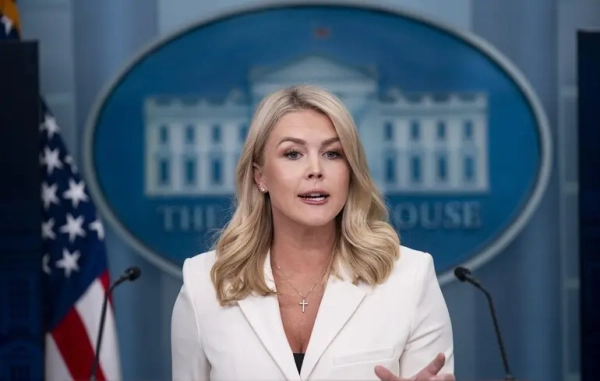
The United States President Donald Trump is urging the legislative body to approve the Save America Act, which would institute more stringent stipulations for voting and voter registration, as stated by White House spokesperson Caroline Levitt this Thursday, February 5.
“The president is suggesting, and I just conferred with him regarding this, that Congressional Republicans and Democrats enact the SAVE America Act,” she announced during a press briefing.
Levitt pointed out that such legislation would make certain that states are in accordance with federal election statutes by removing non-citizens from the voting lists.
She asserted that the proposed law would mandate voters to present identification to cast their ballots and would demand confirmation of U.S. citizenship during voter registration. Levitt portrayed these steps as broadly favored and vital for protecting the integrity of the electoral process.
In a conservative podcast broadcasted on Monday, February 2, Trump proposed that Republican officials take command and “nationalize” election processes in 15 states to shield the party from a power shift. He presented this concept as a way to thwart illegal immigrants from casting ballots. The assertion that non-citizens are voting in appreciable numbers that could sway election results is incorrect; however, it intensifies worries about Trump’s potential endeavors to impact the midterm elections for the US Congress this November, according to The Guardian .
Highlighting his victory by the districts he secured in 2024, and overlooking the considerable population disparities between districts, Trump stated regarding immigrants: “If the Republicans don’t remove them, you’ll never secure another Republican win.”
He further added that immigrants were “brought” into the United States with the purpose of voting, “and they’re voting illegally. And it’s odd that Republicans aren’t being more proactive on this matter. Republicans should assert, ‘We want to seize control.’ We ought to oversee the balloting in a minimum of – 15 locations – Republicans should establish national voting rules.”
Within the United States, the Constitution entrusts each state with the duty of conducting elections within its borders. Congress is authorized to enact laws that safeguard the constitutional entitlements of voters, uphold the principle of “one person, one vote,” and avert discrimination, yet the federal authority lacks control over the election infrastructure.
Trump's declaration surfaced as Congress deliberates on multiple pieces of legislation poised to exert a notable influence on US elections.
Trump’s proposition to “nationalize” elections has stirred responses from legislators, even some Republicans, and Democrats have reiterated their worries that he has intentions to meddle in the midterm elections this November that will decide the balance of power in Congress, Reuters reported .
Democratic officials and advocates for voting rights highlighted that Trump’s remarks, delivered mere days following the FBI’s raid on the Fulton County, Georgia, elections office for 2020 ballots, implied the president’s desire to weaken, or perhaps even manipulate, the outcomes of this year’s midterm elections.
Trump has routinely voiced an eagerness to overhaul the nation’s election system, predicated on unsubstantiated allegations that his 2020 loss to Democrat Joe Biden stemmed from fraudulent activity. He has advocated for a prohibition on mail-in voting, challenged the security of voting machinery, and falsely asserted that millions of individuals who are not citizens regularly cast ballots in U.S. elections.
In recent times, Democrats have unsuccessfully endeavored to enact certain national election reforms, such as comprehensive mail-in voting and addressing particular aspects of voter ID laws.
Two influential Republican figures within Congress, House Speaker Mike Johnson and Senate Majority Leader John Thune, did not endorse the concept of commandeering elections, but they supported Trump’s demands that voters furnish documentation of U.S. citizenship and photo identification.
“I strongly advocate for decentralization and shared governance,” Tun informed reporters on Tuesday, February 3.
Johnson indicated that there was no necessity to seize authority over elections in certain states, but included that Trump’s anxieties concerning the probity of the electoral process were warranted.
Democratic Minority Leader in the US Senate Chuck Schumer stated that the SAVE bill is one mechanism for “nationalizing” elections.
“I want to be explicit: the SAVE bill possesses no prospects of passage in the Senate, and each and every Democratic senator will cast their vote in opposition,” he warned.
Earlier that Monday, Schumer likewise delivered severe disapproval of Trump’s solicitations for Republicans to “nationalize” elections in anticipation of the US midterm elections.
“Does Donald Trump require a copy of the Constitution? What he’s espousing is unequivocally illegal,” Schumer retorted.
Several Trump allies in fiercely contested states confided in Reuters that they foresee Trump potentially threatening to withhold federal funds pertaining to elections from states that oppose fresh voting protocols, such as identification mandates or limitations on mail-in voting.
The government provides states with hundreds of millions of dollars in federal assistance each year to conduct elections, including voting equipment, cybersecurity upgrades, and training for election officials.
Politico reported that Republican Senators Ron Johnson, Mike Lee, and Rick Scott had meetings scheduled with Trump to deliberate on subsequent actions regarding the GOP election bill.
The midterm elections for the US Congress are slated for November 3 of the current year. The Hill reported that Republicans are apprehensive that the unfavorable public sentiment surrounding Trump’s economic strategies, coupled with his stringent stance on deporting immigrants, may trigger a surge of Democratic triumphs that could jeopardize the Republican dominance in Congress. Democrats have previously achieved victory in a progression of municipal elections across the US.
Simultaneously, as assessed by experts, this does not guarantee that the Democratic Party will invariably prevail in the midterm elections to Congress, and historical data suggests that midterm elections during the second presidential term frequently represent a “bloody massacre” for the president’s affiliated party. A “blue wave” is not out of the realm of possibility — in the reverse scenario, there would be a “red wave,” according to a Republican senator speaking to The Hill under assurances of anonymity.
Petro Gerasimenko discussed how local elections impact the political dynamics within America in the article “ Democrats in the US are celebrating victory. But this joy may turn into a political hangover .”