
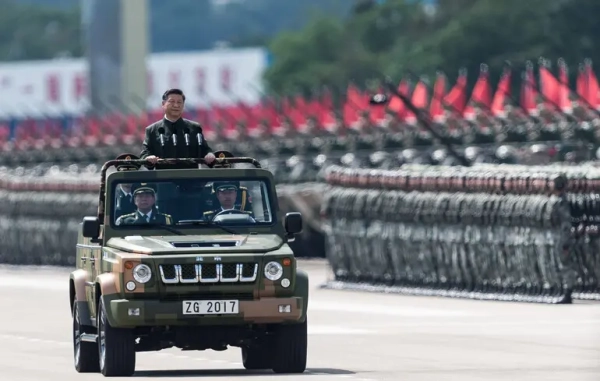
© Getty Images

Viktor Konstantinov,
Towards the close of January, two prominent generals, both members of the Central Military Commission (CMC) — Deputy Chairman Zhang Yuxia and Chief of Staff Liu Zhenli — were relieved of their duties in China. At present, they are subjects of an inquiry related to “severe breaches of discipline and law,” a phrase commonly employed in China to denote acts of corruption.
These two generals represent the latest additions to an extensive register of pivotal party and governmental figures who have faced dismissal or investigation in the past three years. These dismissals are largely regarded as a maneuver by Xi Jinping to reinforce his unchallenged leadership following the 20th Communist Party Congress in 2022, where he was affirmed as the nation’s leader for a subsequent term.
Nevertheless, the eliminations within the military echelon are noteworthy, even when considering the preceding context. The 2022 CPC Congress nominated seven individuals to the Central Military Council of the PRC, including Xi himself (in his capacity as General Secretary of the CPC, he assumes the role of council chairman), and currently, five of these individuals have been stripped of their positions. The Central Military Council is more than just the primary entity for military administration (with the Ministry of Defense, especially under Xi’s leadership, playing a supportive role). The CMC defines the military development strategy, governs the armed forces, oversees their political allegiance, establishes and allocates the defense budget, and exercises direct control over internal forces, military police, and a substantial portion of the nation’s intelligence apparatus. During instances of conflict or crisis, the council serves as the central command authority for the entire nation.
Hence, we are discussing the removal of five individuals from the uppermost tier of national leadership – no other segment of the party or state machinery has experienced such a significant purge. Furthermore, it is essential to incorporate approximately twenty generals at the level of armed forces branch commanders and their seconds-in-command, chiefs of staff, and department heads of the Central Military Commission, who have also been ousted, along with extensive purges throughout territorial commands. Attributing such comprehensive dismissals solely to Xi’s aim to augment command over the nation is inadequate: moreover, virtually all of the recently dismissed high-ranking generals were granted titles and appointments at Xi’s exclusive selection – ostensibly, there were no misgivings regarding their faithfulness to the leader at that juncture.

Infographic Getty Images / translation ZN.UA
The “reshuffling” of military personnel is instigated by multiple elements concurrently, most of which are somehow associated with Xi’s ambitions to reintegrate Taiwan “into its home port.” The principle that “Taiwan is China” is officially sanctioned in the PRC (in 2005, the country even enacted legislation addressing the unacceptability of declaring Taiwan’s autonomy and the legitimacy of employing military force to forestall it). Xi adopts a rather uncompromising attitude on this matter: even Taiwan’s aspiration to pronounce itself as distinct from China seems to him to be an adequate basis for a military intervention. Considering the sentiments of the majority of Taiwanese citizens and the current ruling coalition on the island, hostilities have long since progressed from being a theoretical prospect to a tangible action by the PRC in the foreseeable future.
Accordingly, preparations for the “reestablishment of constitutional order in Taiwan” have evolved into one of Xi’s core themes. The extensive reform of the armed forces, which he initiated in 2016, was essentially devised to forge an “army for a single war” — specifically for Taiwan. The undertaking is substantially more ambitious than it may initially seem, given the backing Taiwan receives from the United States. Therefore, to triumph in this conflict, it is imperative not only to subdue the Taiwanese military but also to dissuade the Americans from aligning with the island’s inhabitants. In broader terms, substantial funding was allocated specifically for the preparation of a singular operation.
As a constituent of the reform, the army was provided not only with amplified funding but also with augmented autonomy to enter into agreements, notably with privately held enterprises. Hypothetically, this was intended to elevate the efficacy of procurement. In reality, it expedited corruption within the armed forces to unprecedented degrees. By 2023, it became manifest that corruption poses a direct menace to the strategic objectives delineated by Xi. An assessment of the condition of the Rocket Forces (the branch of the military entrusted with nuclear deterrence within the PRC) revealed that particular systems failed to satisfy the professed technical criteria, and others exhibited “constrained combat proficiency.” China’s readiness to deter the United States in an impending confrontation over Taiwan was brought into question.
The corruption controversy resulted in the relinquishment of posts and arrests of numerous generals within the Rocket Forces, encompassing their leadership. Former Defense Minister Wei Fenghe (who commanded the Rocket Forces until 2017) and then-Defense Minister Li Shangfu (who, in the initial years of the 2020s, presided over the Central Military Commission’s armaments development division and was directly implicated in procurement for the Rocket Forces) were also apprehended. Li was the inaugural member of the Central Military Commission to be ensnared in the recent surge of purges within the military, and he was designated as Defense Minister upon the individual endorsement of Zhang Yuxia. Zhang, who had maintained a personal acquaintance with Xi since his adolescence (their parents were companions), was previously a confidant of the nation’s leader. The situation involving Li Shangfu’s recommendation arguably represented the primary substantial breach in their association.
The Rocket Forces debacle inaugurated extensive examinations across the armed forces, further impacting Zhang and his immediate circle. Zhang independently oversaw specific domains of armaments development, and his protégés bore responsibility for procurement, notably for air defense and electronic warfare units. Grave transgressions were unearthed within these domains in 2024. The diminution of the Zhang Yuxia faction, which wielded considerable sway within the army, spurred the commencement of an inter-factional dispute amidst diverse factions within the military command. Zhang succeeded in prevailing in this confrontation: in 2025, members of the Central Military Commission, Admiral Miao Hua and General He Weidong, were subjected to investigation, which, in turn, vigorously scrutinized allegations of corruption against Zhang himself. Nonetheless, it appears that Zhang’s adversaries managed to amass fairly compelling materials incriminating him and transmit them to Xi Jinping. As early as the spring of 2025, detentions of his associates commenced.
An additional element that precipitated the purges in the army (and the escalating mistrust between Xi and Zhang) pertained to the stance of certain senior military leaders concerning the formulation of an operation against Taiwan . Xi mandated that the potential for executing such an operation be ensured with utmost haste, both structurally and materially. While military leaders never contested the fundamental notion of a military intervention, they did not endorse the operational preparations for it, and in Xi’s estimation, may have actively hindered it. It is acknowledged that both Li Shangfu and Zhang Yuxia advocated for “more meticulous” (interpreted as — protracted) preparations. Zhang is also rightly credited with impeding endeavors to augment the staffing and fortification of the marines, a component of the Navy. He sought for the army to assume the pivotal role in the capture of Taiwan, notwithstanding its deficiency in requisite resources and training.
The underlying motivations for their actions—whether rooted in a genuine aspiration for enhanced war preparation or a concealed endeavor to misappropriate funds—remain ambiguous. Nevertheless, their perspectives were decidedly irreconcilable with Xi’s political imperatives and, crucially, disregarded international realities — Taiwan might assert independence imminently, altogether dismissing China’s disinclination to engage in warfare. The divergence of perspectives among certain generals concerning the notion of proactive war preparations furnished Xi with an additional rationale to supplant the armed forces’ leadership with individuals who would unquestioningly execute his directives.
The ultimate plausible rationale for the purges (at least for their most recent manifestation in January of the current year) is likewise indirectly linked to Taiwan. The reality is that it was Taiwanese commentators — an abundance of bloggers and specific media outlets — who initially commenced disseminating the narrative last spring that Zhang Yuxia and Liu Zhenli were orchestrating a military putsch to depose Xi from power. The depiction of such a conspiracy was flawless. The generals possessed extensive connections within the army, and Zhang — beyond it, within elevated party circles (as the offspring of one of the esteemed generals from the PRC’s foundation, he maintains personal familiarity with numerous senior party functionaries, including the PRC’s former leader, Hu Jintao), thereby possessing the aptitude to organize a coup. The corruption probe constituted a menace to them and their close associates, respectively, thus affording a basis to resort to extraordinary measures.
By the summer of 2025, the Internet was already awash with “details” concerning the forthcoming coup, with Zhang portrayed in these accounts as the principal adversary and paramount threat to the entirety of the Xi regime. Irrespective of the veracity of these narratives (or their entire absence) and the degree to which the Chinese leader subscribed to the account: Xi was unable to disregard these exchanges, rendering the removal of Zhang Yuxia inevitable. Incidentally, Zhang’s “farewell missives”, wherein he presents himself as a champion of democracy, and “credible intelligence” pertaining to the endeavor to apprehend Xi by Zhang and Liu Zhenli’s individuals in mid-January are presently being promoted by the same myth that was initiated nearly a year prior on social networks originating from Taiwan.
The purges within the PRC’s armed forces constitute an unavoidable reaction to the manner in which individuals formerly loyal to Xi have disillusioned him and undermined his strategic blueprints for Taiwan. Currently, the implementation of these blueprints will necessitate entrusting a new cadre of leaders, with the expectation that they will execute their duties more proficiently. However, the purges also signify that Xi has not renounced his strategies for Taiwan and currently regards military intervention as a contingency.