
 :=”1″ is=”1″ there=”1″ progress=”1″ in=”1″ the=”1″ implementation=”1″ of=”1″ ambitious=”1″ project=”1″ —=”1″ reuters”=”1″ fetchpriority=”high” decoding=”async” width=”630″ height=”340″ />
© EPA/ CHRIS KLEPONIS / POOL The decree that established the framework was signed the previous year on January 27.
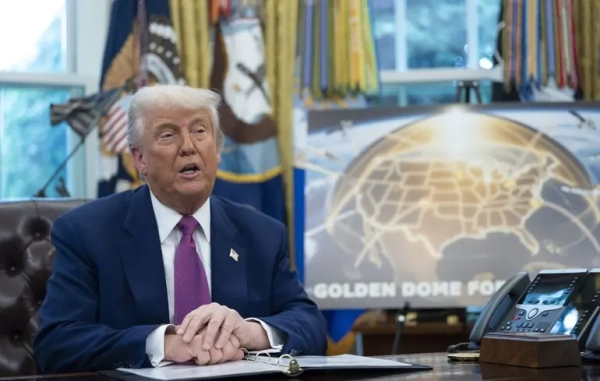
One year following its inception, the “ Golden Dome ” missile defense undertaking by US President Donald Trump has demonstrated minimal advancement, facing hurdles such as technical disagreements and worries regarding components, which have postponed the allocation of billions of dollars, thereby impeding one of the most far-reaching initiatives for national security, Reuters reports.
The Golden Dome directive, endorsed by Trump on January 27, 2025, stipulated a stringent timeline for the deployment of a wide-ranging missile defense framework by 2028. However, a year later, the program is yet to expend a considerable amount of the $25 billion earmarked the previous summer, as authorities are still debating the basic facets of its “space architecture.”
According to two US government officials, efforts on the conclusive edition of the missile defense shield’s “architecture” are still underway, and significant disbursement of resources has not yet commenced. Concurrently, officials indicate that the funding is available, and substantial amounts could be allocated imminently, contingent upon pivotal decisions being finalized. As per a Pentagon representative, the group engaged in the “Golden Dome” project continues to fulfill the aims outlined in the executive order.
“The action plan and related technologies are ever-changing, yet the foundational aspects of the architecture have already been determined. Specifics about the architecture remain confidential,” the US defense official further mentioned.
Golden Dome encompasses the amplification of current land-based defense platforms, like interceptor missiles, sensor arrays, and command systems, along with the incorporation of experimental space-based features intended to identify, monitor, and potentially counteract threats from outer space. These comprise cutting-edge satellite systems and the still-under-discussion orbital armaments.
One factor contributing to the holdup has been internal deliberations concerning sensitive space-based equipment. A defense industry insider, requesting anonymity, suggested that the systems being contemplated were likely to relate to communications protocols. Another source from Reuters noted that they could be anti-satellite weapons — which leads to queries about how such weaponry would integrate into a missile defense network.
The US has traditionally stood against anti-satellite arms because of worries concerning space waste and previously denounced China for conducting tests with an anti-satellite projectile.
Space architecture is still one of the challenges that needs resolution prior to program head General Michael Gatlin’s ability to proceed with a range of procurement agreements.
The U.S. Space Force granted approximately a half-dozen contracts in the preceding November for the purpose of creating competing mock-ups of missile defense systems, including those to Northrop Grumman, True Anomaly, Lockheed Martin and Anduril. The contracts, valued at roughly $120,000 each, represent the preliminary tangible measures in a plan that Trump has projected could ultimately reach $175 billion.
Since December, there has been a minimum of one classified gathering for defense firms pertaining to the structure of the Golden Dome, according to US authorities.
Tom Karako, a senior researcher at the Center for Strategic and International Studies located in Washington, claims that a significant portion of the past year has been devoted to security assessments, staffing choices, and endorsements of intricate schemes. He speculates that the Golden Dome undertaking is unlikely to be entirely fulfilled before 2028.
“Much can be achieved over the ensuing three years to more effectively consolidate what we already possess, though some components will undoubtedly be implemented and refined after 2028,” Karako remarked.
A further unresolved matter related to the initiative is the potential function that Greenland might fulfill. Trump has lately tied the necessity for US dominion over Arctic territory to the missile defense endeavor, frequently asserting that the acquisition of Greenland is of “paramount importance.” However, defense specialists observe that current accords already permit amplified US military operations on the island. One US official clarified that Greenland does not comprise a segment of the envisioned “Golden Dome” architecture.