
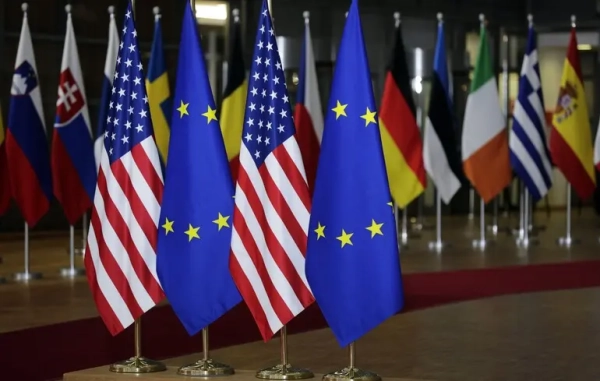
© EPA/OLIVIER HOSLET Trump’s idea complicates Ukraine’s European integration.
Donald Trump’s proposition to establish a free trade area with Ukraine might endanger Kyiv’s aspiration to become a member of the European Union, cautioned Crawford Faulconer, the UK’s former top trade negotiator, The Telegraph reports.
He conveyed that the US President’s concept could notably complicate Ukraine’s attempts at European integration, since EU regulations do not permit member nations to enter into individual trade agreements with external countries.
As per sources, Trump is advocating for the establishment of a “tariff-free zone” in Ukraine, encompassing the elimination of duties and unrestricted commerce in goods from the United States.
Such an arrangement, finalized following a potential peaceful resolution with Russia, could considerably expedite Ukraine’s post-conflict recovery by generating robust incentives for corporations to construct factories within the zone and export merchandise to the United States at decreased expenses.
Nevertheless, Faulconer emphasized that such a project would, in all likelihood, thwart Ukraine’s prospects of joining the EU, given that all nations within the customs union are mandated to cede authority over international trade to the European Commission in Brussels.
“Should Ukraine gain membership in the EU, it will undoubtedly pose a challenge to concluding a free trade pact with the US, as the EU possesses a unified external tariff, determined by the European Commission. The sole means for this to function seamlessly is for the EU itself to engage in a distinct free trade arrangement with the US. However, in my estimation, this seems improbable,” he elucidated.
Concurrently, Faulconer remarked: “Consequently, a technical hurdle exists here. Yet, it does not imply that resourceful individuals cannot devise a solution.”
EU representatives conveyed on Friday that they lacked a definitive grasp of Trump’s proposal, yet cautioned that its implementation could prove “more intricate than the Northern Ireland situation,” which secured special status post-Brexit to avert becoming a “back entrance” to the single market.
Steve Witkoff, Trump’s special envoy for peace discussions between Ukraine and Russia, openly discussed plans to institute a “duty-free zone” in Ukraine for the first time on Thursday at the World Economic Forum held in Davos.
He characterized the concept as a “paradigm shift,” adding, “You’re poised to witness a mass migration of industries to this territory. Envision outperforming your rivals by bypassing tariff payments when dispatching goods to the United States.”
This week, the US President also deliberated this plan with Ukrainian President Volodymyr Zelensky.
It is believed that Trump’s endeavor concentrates on the Donbas, a region largely under Russian control, with the territory’s destiny remaining a critical obstacle in negotiations.
During the same gathering in Davos, Taras Kachka, Ukraine’s Deputy Prime Minister, articulated that Kyiv is mindful of the potential issues stemming from the duty-free zone concerning relations with the EU.
“We must identify a means to integrate Ukraine into the European Union while simultaneously guaranteeing a duty-free system for exports from designated regions to the United States—regardless of the complexities it may introduce from the perspective of EU trade regulations,” he stated.
Simultaneously, indicators of renewed tensions arose this week in the rapport between Ukraine and the EU, with President Zelensky delivering a biting address denouncing the EU for “perpetual internal conflicts” and a “deficit of political resolve” in confronting Vladimir Putin.
Within the EU, an ongoing discourse exists regarding the extent to which standard accession protocols should be eased to expedite Ukraine’s membership.
On Thursday, Dutch Prime Minister Dick Schoof remarked:
“I find it exceptionally challenging, because, considering our current methodology, it will span several years.
“We must be candid, as we seek to prevent destabilizing the European Union itself through excessively rapid country accession.”
He further noted:
“Therefore, we must unearth methods to definitively communicate that the European Union constitutes Ukraine’s ultimate destination, its abode.
However, we must proceed with utmost caution… ensuring Ukraine satisfies all prerequisites for EU membership.”