
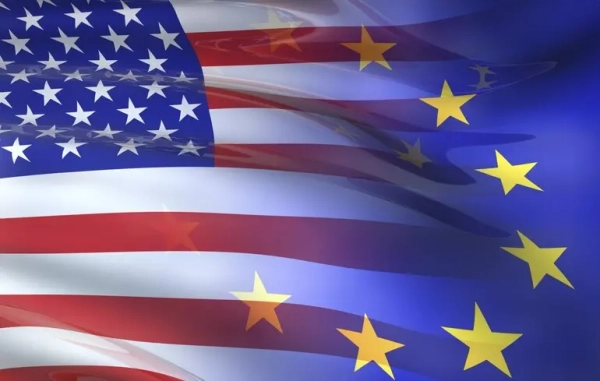
© US Secret Service/Twitter European allies remain suspicious that Trump might alter his stance once more.
EU heads of state will re-evaluate their connections with the United States during an “urgent” meeting this Thursday, January 22. This comes after US President Donald Trump’s threats of levies and his meddling concerning Greenland severely damaged transatlantic confidence, Reuters indicates .
On Wednesday, January 21, Trump unexpectedly retreated from his tariff threats against eight European nations, discarded the notion of employing force to seize Greenland, an independent territory of NATO partner Denmark, and suggested a resolution to the disagreement was nearing completion.
German Chancellor Friedrich Merz, in acknowledgement of Trump’s changed view on the Arctic island, prompted European nations not to hastily dismiss the transatlantic partnership.
However, EU governments are cautious, fearing that Trump might reverse his decision. The present occupant of the White House is progressively regarded as an “opponent.” As a result, the EU is prioritizing the creation of a durable strategy for interacting with the United States, both under the current administration and, potentially, the next.
“Trump has passed the point of no return. He is capable of repeating this. There is no turning back. And leaders will examine this,” expressed an EU diplomat, adding that the European Union must lessen its substantial reliance on the United States across numerous sectors.
“We should attempt to keep him (Trump) engaged while striving to attain greater autonomy from the US. This is anticipated to be a drawn-out undertaking,” the diplomat elaborated.
EU’s Reliance on the US
Following decades of depending on the US for protection within NATO, the EU lacks the essential intelligence, transport, missile defense, and manufacturing capabilities to independently counteract a potential Russian assault. This bestows significant influence upon the US.
The United States also stands as Europe’s foremost trading ally, rendering the EU susceptible to Trump’s tariff strategies aimed at diminishing Washington’s trade imbalance in commodities and, as exemplified by the Greenland situation, realizing supplementary objectives.
“We must deliberate on defining our boundaries, navigating our interactions with this bully on the other side of the Atlantic, and recognizing our inherent strengths,” another EU diplomat stated.
“Trump declares there are no tariffs today, but does that guarantee their absence tomorrow, or will he swiftly alter his perspective again? We need to discuss our course of action in such a scenario,” the diplomat questioned.
The EU contemplated a set of retaliatory tariffs on 93 billion euros ($108.74 billion) worth of US imports, or implementing countermeasures, should Trump enforce his tariffs, even while the EU acknowledged that such a maneuver would adversely impact the economies of both Europe and the US.
Greenland Accord
Several diplomats indicated limited awareness of the fresh proposal concerning Greenland, which Trump and NATO Secretary General Mark Rutte finalized on Wednesday during the World Economic Forum in Davos.
“Not much has been transformed. We still await the comprehensive details of the Greenland arrangement. We are somewhat weary of all this intimidation. And we must undertake action on several fronts: enhanced resilience, cohesion, establishment of an internal market, competitiveness, and an end to tariff-related coercion,” the diplomat articulated.
Rutte affirmed on Thursday that, according to the framework agreement he concluded with Trump, Western allies must bolster their presence in the Arctic, further stating that discussions between Denmark, Greenland, and the United States on particular matters would proceed.
Diplomats underscored that while the “urgent” EU summit in Brussels this Thursday will now suffer some diminution in its pertinence, the enduring inquiry of how to cultivate relations with the US persists.
“The concerted strategy, demonstrating solidarity with Denmark and Greenland, centered on easing tensions and devising a solution to the situation, has proven effective,” the EU diplomat remarked.
“Concurrently, it would be advantageous to reflect on the condition of our relations and how we intend to mold them in the future, considering the experiences of the past week (and year),” he appended.
Politico reported that European governments have reached the disheartening realization that Americans are now perceived as “antagonists” – a sentiment particularly pronounced in nations that formerly maintained the closest associations with Washington. The conviction that the US is no longer a dependable partner has steadily solidified amidst the Trump administration’s pronouncements and actions.
The initial year of Trump's second term has demonstrated the United States’ rapid progression towards the model of an “imperial presidency,” while the world gravitates towards a policy of power and spheres of influence. Where is America progressing under Trump's leadership and why does it represent a hazard, and not just for America itself? Oleg Shamshur addressed this subject in the article ” Trump's Anniversary 2.0: No Brakes .”