
© Getty Images

Oleh Shamshur
A year has elapsed since the outset of Donald Trump's second stint as president. Merely a year, yet within this comparatively brief timeframe, the occupant of the White House has contrived a reality, encompassing both the United States and global affairs, which stands as a substantial alternative to its predecessor prior to his subsequent “ascent” to authority.
Trampoline inside
Notwithstanding his hallmark inconsistencies and displays of temperament, Trump has largely operated in accordance with a strategy predicated on the insights gleaned from his inaugural presidency and the stinging setback in the preceding electoral contest. Those asserting that his ostensibly public-facing radical pronouncements, such as his avowal to render his successive tenure a “retaliatory presidency,” were justified in affording them due gravity.
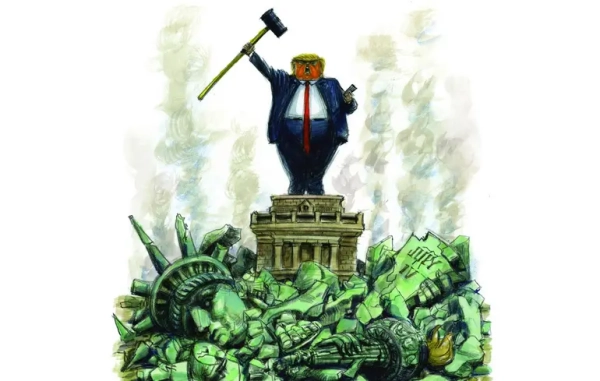
The endeavor to broaden the prerogatives of the executive division, a characteristic shared by virtually all US leaders, has manifested as features of an “imperial presidency” in Trump, where presidential sway disregards constitutional bounds, diminishing the tenet of institutional checks and balances, a cornerstone of American democracy, thus engendering the peril of undue fortification of presidential authority at the expense of alternative echelons of the state structure and its misapplication. As per American legal experts, no antecedent president in US annals has “assessed the resilience” of the nation’s Constitution and sought to augment presidential command to the degree that Trump is presently pursuing.
To attain this aim, the incumbent US president consistently leverages legislative statutes designated for exigency scenarios (notably, to rationalize the imperative to deploy the US military on US soil), systematically undermines autonomous entities established by Congress to oversee the executive branch, and endeavors to curtail the fiscal entitlements of the legislative arm. Contrary to the American political ethos, which posits that the Department of Justice possesses a degree of independence, the incumbent US president has transformed the Department of Justice into an instrument for settling grievances with political adversaries and “transgressors”. Trusting the declarations of White House Chief of Staff Susie Wiles, Trump is convinced he can undertake “whatever he desires.”
The fulfillment of Trump's aspirations is bolstered by the dominion he has imposed over the Republican factions commanding a majority in both chambers of the US Congress. Until recently, this sway was near absolute, guaranteeing the ratification of presidential legislative initiatives. Foremost among these is the so-called expansive and elegant bill, consolidating Trump's priorities in fiscal and societal policy, curtailing various “eco-conscious” endeavors, and amplifying funding for immigration agencies and military expenditure. Congress has essentially ceased to execute its role as a “deterrent” to presidential authority : Republican legislators – with infrequent exceptions – champion even the most contentious presidential actions, both domestically and internationally. Rifts within the Republican bloc have only commenced to surface in recent months, stemming from the controversy surrounding the release of pedophile Epstein's records, the president's proposal to rescind healthcare entitlements, and the discord regarding his foreign policy competencies amid occurrences in Venezuela and his designs concerning Greenland.

Most Americans do not support Trump's desire to acquire Greenland – poll
A pivotal factor favoring Trump is the existence of a conservative preponderance within the ultimate legal arbiter of the United States – the Supreme Court of the country. During 2025, the court adjudicated 24 cases tied to the actions of the incumbent administration under an accelerated protocol. In 20 cases, it rendered verdicts supportive of the administration. Equally advantageous for Trump is the stance of the appellate judges, whom he designated during his initial presidential term. Consequentially, questions arise regarding the capacity of the US legal framework to withstand the president’s “imperial” inclinations , albeit in December, the US Supreme Court proscribed the utilization of National Guard detachments in Chicago.
Throughout the opening year of his renewed tenure, Trump has channeled considerable endeavors towards “deconstructing” the state administrative structure , reshaping it in accordance with his objective of debilitating conventional elites and eradicating the “deep state,” which, according to conspiracy theorists, dictates governmental strategy. Upon the inception of the fresh administration, aided by a specifically chartered Department of Government Efficiency helmed by Elon Musk, substantial cutbacks were enacted upon civil servants, and numerous federal entities (exemplified by the Agency for International Assistance) were either abolished or underwent drastic overhauls. The president acknowledged that the subject of enhancing public administration efficiency resonates with public sentiment .
However, these “reform” initiatives, while executed under the banner of countering malfeasance among professional bureaucrats, constituted a facet of the Trump team’s strategy to dishearten political opponents and secure unwavering allegiance from civil servants . Notably, Trump dismantled the mechanism of independent inspectors general, instituted by Congress to combat inefficiency and transgressions within government bodies. Within the state apparatus and society writ large, a tacit prohibition was enforced against preferential programs catering to racial and other minorities. In this instance, the president and his cohort capitalized on the existence of tangible predicaments concerning the specification of parameters and the execution of such programs for their political advantage, thereby inciting discontent among certain Americans.
During his initial term, Trump astutely discerned the anxieties of the majority of American citizenry concerning the magnitude of illegal immigration . He designated this grave issue as the central motif of his subsequent electoral campaign, pledging its resolution upon his reelection. He promptly succeeded in sealing the southern boundary, virtually eradicating the influx of undocumented immigrants traversing it. He also instituted measures to regulate and circumscribe legal migration, encompassing the entry of refugees into the United States. Emphasis was placed on coercive methodologies: Immigration and Customs Enforcement, whose fiscal allotment was tripled , effectively secured carte blanche to orchestrate extensive operations to deport undocumented immigrants, during which its personnel frequently resort to brutal practices. Concurrently, the targets of federal law enforcement scrutiny predominantly become cities and states governed by Democrats . Consequently, one may infer that the further intensification of the anti-immigration campaign aligns with the strategy of consolidating Trump's leadership footing and enfeebling his rivals from the Democratic Party and their adherents: official sources depict them as agents of disorder and lawbreakers.
According to an Associated Press poll , 76% of Republicans persist in endorsing Trump’s immigration policies (relative to the national mean of 38% ). The bulk of them sanction the modalities by which undocumented immigrants are being expelled. The Republican foundation endures in supporting their “champion”: 8 out of 10 Republicans voice contentment with his presidential conduct, and two-thirds opine that constructive transformations are transpiring within the nation. Certainly, this cannot but gratify the president’s self-esteem and galvanize him to perpetuate the identical political trajectory and execute presidential duties in a manner that dispels any ambiguity regarding his own rectitude and eminence.
Concurrently, it warrants attention to the flip side. It subsequently materializes that not two-thirds, but rather approximately half of Trump voters express gratification with their personal affluence, marginally over half believe that the incumbent president's endeavors have contributed to job creation, and solely 40% note that he has “minimally” facilitated the augmentation of living standards. This registers significantly below the evaluations of his endeavors in the fiscal arena during his maiden term. As per economists hailing from Yale University in the USA, the ramifications of the implementation of Trump's “expansive and elegant bill” will chiefly impinge upon members of his fan base, who belong to households spanning middle and lower-middle income brackets. The dissatisfaction permeating the American populace concerning the state of affairs within the economy is elucidated by the enduring negative national approval rating of Trump – -16% in January of the current year.
Given the persistence of relatively elevated prices for a substantial array of indispensable commodities, coupled with the precarious predicament within the real estate domain, discourse revolves around an “affordability crisis” in the United States concerning goods and services. Considering the favorable metrics of economic expansion, the dearth of any conspicuous repercussions from tariff disputes upon inflation, the surge in genuine wages for Americans, and the condition of financial marketplaces, Trump endeavors to disregard or, at minimum, trivialize the gravity of this quandary, labeling it a “mystification.” Merely under duress stemming from the “perquisites” of the Republican Party has he propounded a sequence of proposals to surmount the “affordability crisis”: illustrative instances encompass proposals to disburse a bonus of $2,000 from tariff revenues to selected US citizens or to curtail credit card debt servicing levies. These initiatives manifest as declarative, given the current absence of a mechanism for their realization.

Americans Disapprove of Trump's Approach to Resolving the War in Ukraine — Poll
Nonetheless, it remains self-evident that the outcomes of the midterm congressional elections slated for November of the current year will be decisively swayed by economic determinants , alongside the burgeoning discontent among Democrats and, critically, independent voters vis-à-vis the authoritarian methodologies of presidential governance. Notwithstanding public bravado, Trump and his entourage maintain a lucid awareness that the attainment of a majority by Democrats in, at minimum, the House of Representatives could terminate anticipations for the perpetuation of the “imperial presidency”, given that Democratic legislators will exert decisive authority over the budgetary procedure and the capacity to initiate investigations targeting members of the administration. Not without justification has Trump alluded to the prospect of a renewed impeachment and, in tandem with his cohort, is actively scrutinizing avenues to avert an unfavorable outcome in the midterm elections for himself (exemplified by the alteration of electoral district configurations).
Pax Trumpiana outside
A Democratic triumph in November appears merely plausible. Until that juncture, virtually the singular restraining element upon Trump's “propensities” will be his “morality”. This holds utter applicability to world politics . It was in connection with the US president's forceful actions on the international stage that his pronouncements concerning “morality” were articulated. Here, diverging from Trump's conduct on the domestic terrain, which was rather predictable and even preemptively announced, we witnessed an expanded elucidation of the tenets by which the 47th US president and his supporters aspire to render America great anew on a global scale.
The incumbent Trump variant of the US security strategy, extending a nod toward “non-intervention” as the bedrock of the state's foreign policy since its very inception, posits that the presence of “myriad and diverse” interests within the US renders it untenable to rigidly adhere to the principle of “non-interventionism”. Ergo, transitioning from the neo-isolationism evinced in campaign speeches, which resonated with the prevailing sentiments of the Republican base, to the “Trump doctrine”. It, in the depiction of US Vice President J.D. Vance, unfolds as follows: 1) within each discrete instance – a lucid delineation of American interests and requisites; 2) subsequently – “aggressive diplomacy” to resolve the quandary; 3) should this fail to yield the desired outcome – the deployment of “overwhelming military force” for a circumscribed duration, with the aim of precluding a “protracted conflict”. Adhering to such prescriptions, strikes targeting Iranian nuclear program facilities and the abduction of Maduro were envisioned and executed.
The latest operation signifies the protracted maturation of Trump's geopolitical ambitions. At a minimum, in relation to the Western Hemisphere, dominance wherein is now construed as the paramount priority of US foreign policy. Here, Trump and his cohort stand poised not to confine themselves to ad hoc actions, but rather to seize command of entire states and territories with the intention of exploiting their natural wealth and/or strategic positioning (Greenland), disregarding such “trivial” considerations as international legal frameworks, the interests of the local populace, and rapport with conventional allies. The paramount criterion resides in its alignment with the political and allied interests of the incumbent president, his lineage, and business magnates and politicians in proximity to the White House.
Democrats in the US are celebrating victory. But this joy may turn into a political hangover
Arguably, never before has the United States borne witness to such a magnitude of personalization of foreign policy, its dependence on the interests, inclinations, emotions, and even caprices of an individual. Notably, Trump's fixation upon Greenland or his aspiration to integrate Canada as the 51st state are further elucidated by his ambition to maximize the expanse of the United States for prestige-related considerations, in the hope of securing a place in history as a “collector” of North American territories.
The campaign against “eternal wars,” which defined Trump’s 2024 electoral pursuit, is undergoing a transformation into the construction of Pax Trumpiana , a world subsequent to Trump. The tenets governing existence within it will be ordained by principal actors — encompassing the United States, China, Russia, and potentially additional states guided by formidable leaders esteemed by Trump — in contradistinction to the Europeans, whom he regards with near disdain (he would favor substituting the European liberal order with the potency of “true patriots” analogous to Orbán, ideologically proximate to the Trumposphere). Alternative, more enfeebled states must “acknowledge their position” and calibrate their deportment contingent upon the interests and demands of the “eminent ones.” Substantially, such a paradigm of world politics signifies reverting international engagements to the state prevailing during the 19th and early 20th centuries, wherein potency and might constituted the sole determinants . As per one of the closest advisors to the incumbent president, Stephen Miller, “this immutable law has governed the world since its very nascence.”
The ensuing stride entails Trump’s endeavor to transmute the paradigm of interactions with conventional rivals China and Russia from competition to agreements and even collaboration. As Axios astutely noted, Trump’s emergent world order entails “brokering accords among great powers and, when warranted, turning a blind eye to each other’s ambitions rather than constraining them.” The coexistence of great powers remains untenable sans the acknowledgement of spheres of influence, which constitutes the cost of stability.
Upon closer scrutiny of Trump's actions, as opposed to his “threatening” pronouncements directed at China and Russia, we discern his adherence to this precise rationale. Having commenced by imposing super-tariffs upon Chinese commodities, the US president subsequently retraced his steps, consenting to a tariff truce and even authorizing the sale of chips requisite for the advancement of AI technologies to China. Contrarily, he menaces the employment of the tariff “club” against European allies who possess the audacity to champion Denmark in opposing his Greenland reveries, which imperil the destabilization of NATO.
Throughout the opening year of Trump's subsequent term, his Ukrainian policy has traversed a complete revolution: commencing with an “ambush” within the Oval Office, it has culminated in accusations of the Ukrainian president's disinclination to attain peace. Why did this transpire? The response lies in the determination of this policy by four elements. Firstly, Trump aspires to terminate the hostilities in Ukraine at any sacrifice, inclusive of Ukraine's national imperatives. Secondly, he does not deem Ukraine a nation of strategic consequence to the United States and Trump personally. Thirdly, European states are delegated the role of predominantly executors of Trump's eccentricities and his concordats with the Russians. Fourthly, he perceives “fantastical” prospects for the execution of business megaprojects with Russia and anticipates leveraging it to transmute the rules of engagement within world politics (facilitated by the similarity between Trump and Putin's perception of organizing international relations). Concurrently, the 47th US president occasionally voices displeasure with the Kremlin ruler's defiant conduct, as he effectively regards himself as the “director of the universe,” whose volition must be obeyed by alternative participants in international communication.
These disagreeable facets should be borne in mind to accurately ascertain the overarching trajectory and nuances of conduct in negotiations with partners originating from both sides of the Atlantic and to realistically appraise their propositions. Particularly amidst circumstances wherein our latitude for maneuver is severely circumscribed, and the ensuing years of Trump's subsequent term do not portend particularly auspiciously for Ukraine.