
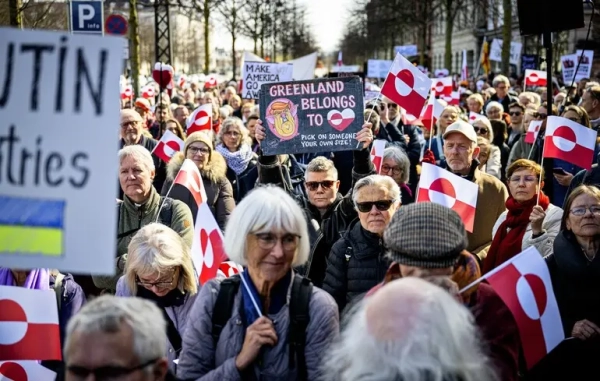
© EPA/NILS MEILVANG Is the American president capable of such imprudence as to endanger the obliteration of America’s strongest partnership?
President Donald Trump’s eagerness to amplify America’s involvement in Greenland, citing reasons of homeland defense, is not without cause. He conceivably could promptly secure a pact with Denmark, which governs the self-governing territory, to broaden U.S. military presence and investments on the Arctic territory. Nevertheless, Trump’s audacious pronouncements about purchasing or confiscating Greenland have ignited a predicament that might impair U.S. security for decades—dwarfing any potential advantages of dominating the island, according to columnist David Ignatius in a recent piece for the WP .
“Self-sabotage” seems too gentle to depict Trump’s maneuvers. A more apt comparison would be to inflict a fatal wound upon oneself, Ignatius observes.
Trump’s fixation on Greenland, steadily mounting since 2017, initially appeared as yet another instance of his “19th-century nostalgia.” The Danish administration originally embraced a subdued strategy, discreetly circulating proposals for a fresh security understanding. However, Denmark, alongside the rest of Europe, discerned this month that Trump harbored genuine intentions of commandeering the island, potentially through forceful means.
“No one will engage in combat with the US concerning Greenland’s destiny,” Trump advisor Stephen Miller asserted on Monday, January 5.
“The employment of U.S. military strength is invariably an option,” White House press secretary Caroline Levitt articulated the subsequent day.
Considering Trump’s inclinations, dialogues about military avenues concerning Greenland could merely constitute a tactical gambit in negotiations. He covets a tract of land and is intimidating the proprietor with decimation to coerce a sale. The implied proposition to Europe might be articulated as: I am willing to provide protection against Russia; the stipulation is Greenland. Yet, forecasting Trump’s actions proves challenging. Venezuelan leader Nicolas Maduro similarly entertained the notion that Trump was feigning.
Triumphs in military endeavors embolden any White House cabinet. In the aftermath of the undertaking to apprehend Maduro in Caracas the prior weekend, Trump and his associates commenced speaking in the vernacular of 19th-century colonialism.
Trump commenced conversations regarding Greenland with his advisors back in 2017. His captivation seemed somewhat rational: the Arctic constitutes a burgeoning theater for rivalry amongst major powers, and the territory, governed by Denmark, possesses noteworthy strategic significance. Within these exchanges, Trump lamented that the United States previously enjoyed unfettered access to Greenland during the Cold War but had relinquished it.
At the time, it resembled more of a presidential fancy rather than a calculated approach. Upon the publication of a Wall Street Journal dispatch in 2019 detailing Trump’s yearning to procure Greenland, the island’s Foreign Ministry playfully remarked via Twitter: “We welcome commerce, yet we are not available for acquisition.”
Trump grappled with numerous additional preoccupations throughout his inaugural term, and aides readily steered him back to pragmatism. Nevertheless, in the wake of his sweeping electoral triumph in November 2024, the notion resurfaced with amplified intensity. He proclaimed that “to safeguard homeland defense and liberty across the globe, the United States of America deems possession and dominion over Greenland an unequivocal prerequisite.”
“We must guarantee Greenland’s integration into the United States. … Let us undertake it,” Louisiana Governor Jeff Landry contributed to the discourse.
The preceding month, Trump designated Landry as a special ambassador to the island.
Danish authorities have privately affirmed to the White House that military coercion proves superfluous. The United States already maintains a military installation on the island and possesses the capacity to augment troop numbers without constraint. Moreover, the United States retains entitlement to unrestricted entry and transit amidst the defense localities traversing Greenland “by land, air, and sea” in accordance with a 1951 accord, which, despite revisions, remains operative.
Trump hardly represents the initial American statesman to aspire to jurisdiction over Greenland; however, his forerunners faced limitations imposed by the imperative of upholding alliances.
In 1955, when U.S. Secretary of Defense Charles Wilson queried Admiral Arthur Radford, chairman of the Joint Chiefs of Staff, regarding the military’s disposition toward Greenland, Radford avowed its “axiomatic” nature. Nevertheless, he cautioned, “political and economic dilemmas loom.” In 1959, the U.S. State Department, within a review of the potential acquisition, noted that “the juncture wherein such a design would be viable has receded into the distant past,” and cautioned: “Greenland constitutes . . . an indivisible element of Denmark, akin to the status of the state of New Jersey as an intrinsic constituent of the United States.”
The Trump faction, thus, pursues an objective that even the administration of erstwhile US President Dwight Eisenhower dismissed at the pinnacle of the Cold War. In March, the intelligence community disseminated a threat appraisal for 2025 that forewarned of both Russia and China encroaching upon Greenland. Concurrently, US Vice President J.D. Vance undertook a concise symbolic sojourn to the Arctic landmass, igniting demonstrations from Greenlanders and remonstrations from the Danish government.
As 2025 loomed, Danish officials started to harbor anxieties that the White House was incorporating instruments of intelligence into its initiative. As reported by the Wall Street Journal, in late April, U.S. Director of National Intelligence Tulsi Gabbard dispatched a “priority intelligence gathering message” to intelligence apparatuses, impelling them to amass data pertaining to Greenland’s independence movement and public sentiments concerning an augmented U.S. involvement. In August, Denmark’s state broadcaster DR disclosed that three U.S. nationals had participated in clandestine “influence operations” on the territory. Danish Foreign Minister Lars Løkke Rasmussen denounced the meddling as “unacceptable.”
“The United States is wielding economic leverage, encompassing menaces of elevated tariffs, to impose its decree, and the prospect of resorting to military might — even when directed at allies — is no longer dismissed,” Danish intelligence cautioned the preceding month within its annual threat assessment.
The Trump administration has administratively recast the map. According to Ignatius’ informants, the Greenland quandary is “addressed” by the US National Security Council representative accountable for the Western Hemisphere. In other words, Denmark may fall within the European domain, yet Greenland does not.
An attribute of Trump’s stratagem in deal-making lies in his imposition of duress upon Denmark amidst a period wherein all European nations grapple profoundly with the peril manifested by Russian dictator Vladimir Putin. Given their vulnerable state, the opportune moment arises to exert influence for securing concessions. This pitiless method has rendered Trump a pariah among New York’s business aristocracy for decades.
Danish Prime Minister Mette Frederiksen cautioned this week that should Trump sustain the imposition of pressure, he might dismantle NATO. Concerns mount amongst Europeans: Could Trump possibly exhibit such recklessness as to jeopardize the annihilation of America’s paramount alliance?
If European governments previously underestimated the magnitude of Trump’s threats to annex Greenland, they now comprehend it. Politicians are no longer disregarding the American leader’s heightened pronouncements and are frantically devising a strategy to thwart him: Politico has delineated Europe’s alternatives .