
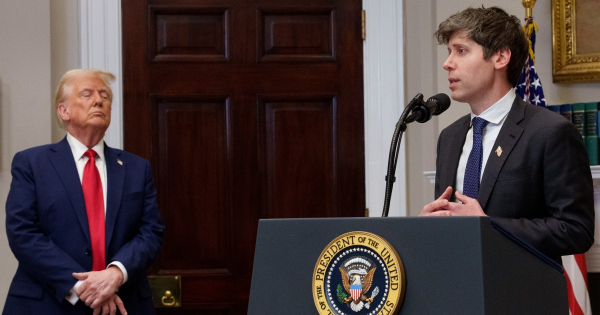
OpenAI CEO Sam Altman has gone from critic of US President Donald Trump to ally of his. Now the entrepreneur’s company is shaping the White House’s AI agenda, lobbying for the Stargate project in Abu Dhabi and competing for political influence amid a conflict with Elon Musk. The main thing from the WSJ material is how the head of OpenAI changed his political views to gain access to key decisions in the US
Buy an annual subscription to 6 Forbes Ukraine magazines with informative materials, ratings and analytics from UAH 1,350 .
Two weeks after Tesla CEO Elon Musk’s public spat with US President Donald Trump, OpenAI CEO Sam Altman entered the president’s golf club in New Jersey as a welcome guest. The president introduced Altman as “a very intelligent person,” contrasting with the cold atmosphere of the first weeks of his term. Altman had been kept aside at the time because of Musk’s closeness to the new head of the White House. Instead of a seat at the podium during Trump’s inauguration, the OpenAI CEO sat in a spare room, waiting for a moment to regain his influence.
Musk’s departure from Trump’s inner circle opened the way for Altman: he quickly built personal contact with the president, concluded deals on AI infrastructure, and gradually changed public rhetoric.

Popular Category Money Date Yesterday “A 180-degree turn.” The Rada abolished the independence of NABU and SAPO. What does this mean for the work of anti-corruption bodies and relations with partners?
Musk, a Democrat who recently compared Trump to
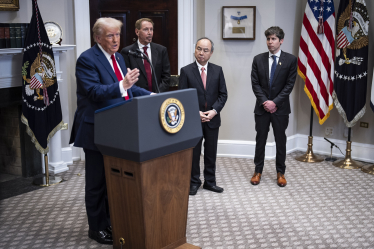
Although OpenAI CEO Sam Altman donated $1 million to Donald Trump’s inauguration, he did not support any candidates during the election. Photo: Getty Images
“Warming” of relations with Republicans
In the spring of 2024, OpenAI began reaching out to Trump as part of its bipartisan work. Altman and OpenAI’s senior management team decided to appeal to the future president’s experience as a developer and his love of winning. They positioned OpenAI as a leader in AI and impressed Trump with their technology. It worked.
In June 2024, OpenAI executives met with Trump at a Las Vegas hotel and demonstrated the then-unreleased Sora text-to-video generator, which was supposed to “scare” Hollywood by the end of the year. They also presented the case for government investment in AI infrastructure and the elimination of American regulations and environmental inspections to bypass China.
A few days after that meeting, Trump told podcaster Logan Paul that the US needed to “get ahead of China” in AI. By the Republican National Convention in July, the need to build AI infrastructure had become part of Trump’s agenda. A week later, Sam Altman supported the idea in a column for the Washington Post. At the time, he said that “infrastructure is part” of the struggle between “democratic” AI, controlled by the US and its allies, and “authoritarian” AI, controlled by countries like China and Russia.
The battle for the president’s attention
After Trump won the presidential election, Altman had to compete with Elon Musk for influence over the new US Administration’s AI agenda. Musk became the largest donor to Trump’s presidential campaign, openly clashed with Altman, and attacked OpenAI through his company xAI with a series of lawsuits. This limited Altman’s ability to meet Trump directly – he secured access through connections in the president’s inner circle, including lobbyist Jeff Miller and Oracle CEO Larry Ellison.
But Altman made a major financial gesture, donating $1 million to Trump’s inauguration, which became a ticket into the new US government, albeit without a prominent role in public. Altman received recognition when, together with Trump, Ellison and SoftBank CEO Masayoshi Son, he announced the creation of the Stargate project. Its goal is $500 billion in investments in data centers to break through AI infrastructure, with the expectation of a competitive advantage for the US over China.
Upon hearing about the deal, Musk immediately criticized it on social media and questioned SoftBank’s financial viability. In response, Altman wrote about his political shift: “I won’t agree with him [Donald Trump] on everything, but I think he’ll be incredible for the country in many ways!”
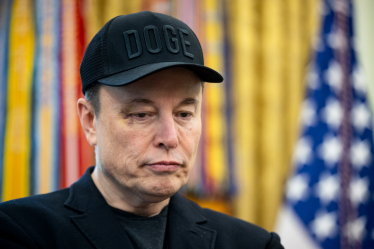
Elon Musk has finally lost Donald Trump’s trust after a deal to build data centers in Abu Dhabi for OpenAI. Photo Getty Images
Exit to the United Arab Emirates
The Trump administration has supported OpenAI’s infrastructure projects by signing the Unleashing American Energy Executive Order to streamline energy project permitting. In January 2025, the U.S. president’s representatives attended the AI Summit in Washington, D.C. In March of that year, Altman attended a Trump donor dinner.
In May 2024, OpenAI and the White House announced the Stargate project, a 5GW data center in Abu Dhabi, in partnership with local company G42, Oracle, and SoftBank. The project became possible after the lifting of US restrictions on chip exports. Musk, who had vested interests through xAI and ties to G42, tried to block the announcement, which caused tension with Trump.
The deal was announced, but on a smaller scale. After that, Musk and Trump finally broke off relations. Meanwhile, Altman became closer to the US Administration, received a $200 million Pentagon contract, and is actively lobbying to simplify the construction of AI infrastructure, including the transfer of federal lands for data centers.
“I believe in technocapitalism,” Altman explains his political stance. “We should encourage people to make big money, and also find ways to distribute wealth and share the magic of capitalism.” Altman’s inner circle says he may now vote Republican in the next election.